

From Education to Action: Preparing Students for Global Sustainability Challenges
Ten years into the 2030 Agenda for Sustainable Development, the world still struggles to measure its own progress. The Sustainable Development Goals (SDGs) break down into targets, which collectively include 232 indicators.
Sustainability Must Extend Beyond Environmental Studies
Sustainability is often associated with environmental science, renewable energy, or conservation. Yet global sustainability challenges involve much more than protecting ecosystems. They include economic inequality, public health, urban development, responsible consumption, technological innovation, and access to essential resources. Addressing these issues requires people with different areas of expertise to understand how their decisions affect society and the environment.
Universities can make sustainability a shared educational priority by incorporating it into different disciplines. Business students can examine ethical supply chains and sustainable investment. Engineering students can explore energy-efficient infrastructure and waste reduction. Healthcare students can study the relationship between environmental conditions and disease. Law students can investigate environmental regulations, climate policy, and access to justice. Students in communications and media can learn how scientific information is presented, interpreted, and sometimes misrepresented.
This approach helps them recognize sustainability as a practical concern within their future professions. They begin to understand that decisions about production, construction, healthcare, finance, technology, and public policy carry consequences beyond immediate outcomes. Integrating sustainability into diverse academic programs also ensures that graduates who may never work directly in environmental fields develop the knowledge and awareness to make responsible professional and personal decisions.
Also Read: Nurturing Eco-Conscious Minds: Environmental Education for a Sustainable Future
Learning Through Real-World Sustainability Problems
Understanding sustainability requires more than reading about global challenges or memorizing scientific concepts. Effective sustainability education involves students investigating problems, interpreting evidence, test ideas, and assessing the consequences of possible solutions. Experiential learning makes these connections clearer by bringing academic knowledge into practical situations.
Universities can incorporate sustainability challenges into coursework, laboratory activities, research assignments, and collaborative projects. Instead of treating sustainability as an abstract concept, learners can examine issues within their own communities and develop solutions based on scientific evidence.
For example, learners could investigate water quality in nearby lakes or rivers, assess food waste in campus cafeterias, analyze energy consumption in buildings, study urban heat patterns, or examine the accessibility of public transportation. These activities introduce them to research methods, data collection, problem-solving, and the limitations of proposed interventions.
Projects can also involve young professionals from different disciplines. Urban sustainability projects might bring together architecture students to design energy-efficient buildings, engineering students to assess infrastructure, economics students to evaluate costs, and social science students to study community needs. This collaboration mirrors real-world approaches where sustainability challenges are addressed outside universities, with effective solutions drawing on expertise from multiple disciplines.
The emphasis should be on investigation and informed decision-making, not simply completing an assignment. The student community needs to understand why a problem exists, what evidence supports different approaches, who is affected, and how success could be measured. These experiences help build the confidence and practical skills required to contribute to sustainability initiatives in their future careers.
Making Science Engagement an Active Learning Experience
The International Day of Engagement in Science for Sustainable Development draws attention to the importance of involving people in scientific understanding and its application. For universities, this presents an opportunity to rethink how they interact with science. Engagement should involve asking questions, exploring evidence, contributing ideas, and participating in solutions.
Classroom discussions, student-led investigations, research presentations, innovation challenges, and collaborative workshops can make scientific learning more participatory. The next generation should be encouraged to question assumptions, compare findings, examine uncertainty, and understand how scientific evidence informs decisions.
This is particularly important when sustainability issues involve competing priorities. Renewable energy projects, for instance, may offer environmental benefits while raising concerns about land use, cost, local livelihoods, and infrastructure. Graduates who examine these different perspectives gain a more balanced understanding of how scientific knowledge interacts with social, economic, and political considerations.
Science engagement also extends beyond university campuses. Knowledge seekers can participate in public awareness campaigns, community research, local environmental monitoring, and science communication activities. Explaining research findings to non-specialist audiences encourages them to communicate clearly, recognize public concerns, and make scientific information accessible.
When they become active participants in scientific inquiry, they are more likely to view science as a tool for understanding and addressing shared challenges, rather than knowledge confined to textbooks, laboratories, or specialized careers.
Building Essential Sustainability Skills Across Disciplines
Preparing graduates to address sustainability challenges requires universities to develop a combination of scientific understanding, analytical ability, collaboration, and practical problem-solving. These competencies are relevant across professions and can be strengthened through different learning approaches.
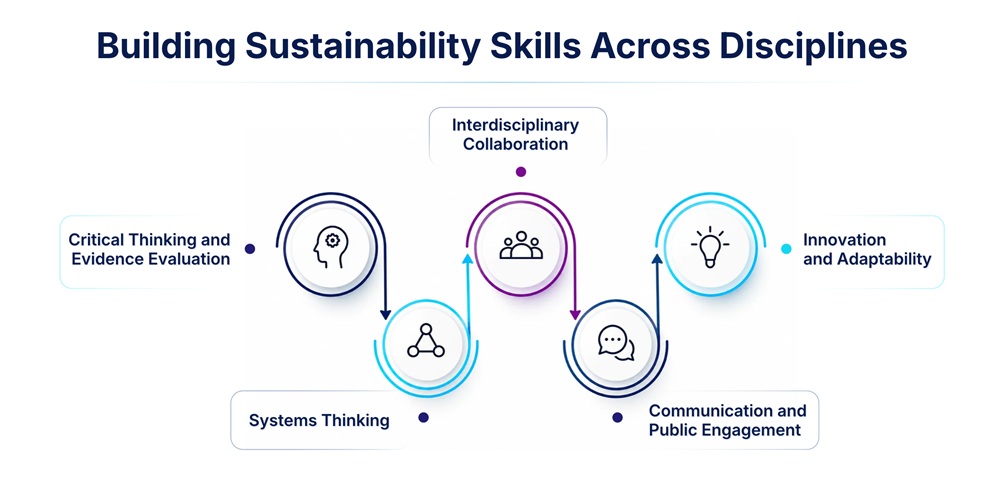
- Critical Thinking and Evidence Evaluation: Future researchers should learn to distinguish scientific evidence from misinformation, assess the credibility of sources, interpret data, and recognize uncertainty. These abilities are particularly important when engaging with topics such as climate change, pollution, public health, and resource management.
- Systems Thinking: Sustainability challenges rarely exist in isolation. Learners need to understand how environmental, economic, social, and technological factors influence one another. Examining these relationships helps them anticipate unintended consequences and evaluate solutions more comprehensively.
- Interdisciplinary Collaboration: Working with students from different academic backgrounds encourages them to consider perspectives beyond their own specialization. It also prepares them to work with diverse teams in professional environments where complex problems require shared expertise.
- Communication and Public Engagement: Graduates should be able to explain research findings, discuss sustainability concerns, and communicate practical recommendations to different audiences. These skills are important for building public understanding and encouraging informed participation.
- Innovation and Adaptability: Students should be encouraged to explore new approaches, test ideas, learn from unsuccessful attempts, and adjust their solutions when circumstances change. This develops the flexibility required to respond to emerging sustainability concerns.
These skills should be developed through regular academic experiences, not treated as an additional set of competencies students acquire only through optional workshops or extracurricular activities.
Connecting Universities with Communities
Universities can strengthen sustainability education by building closer relationships with the communities around them. Local communities experience environmental, social, and economic challenges directly, and their knowledge can provide valuable insights into problems that academic research alone may not fully capture.
Community-based learning allows students to work with local organizations, public institutions, businesses, and residents on projects that address real needs. Scholars might help assess waste management practices, conduct surveys on public transportation, study local biodiversity, support water conservation initiatives, or develop educational resources on public health and environmental awareness.
Such partnerships also introduce students to the practical constraints that influence sustainability decisions. A solution that appears effective in theory may not be affordable, accessible, culturally appropriate, or easy to implement. Community engagement helps students understand these limitations and consider the experiences of people affected by proposed changes.
Universities should also create opportunities for students to contribute to campus sustainability initiatives. Participation in energy conservation, recycling, sustainable food programs, biodiversity projects, and responsible resource management can turn the university itself into a learning environment. Learners can monitor progress, collect data, evaluate existing practices, and recommend improvements.
The value of these experiences lies in meaningful participation. Student talents should have opportunities to contribute to planning, implementation, and evaluation, with their findings informing actual decisions wherever possible. This makes engagement more purposeful and helps students understand how scientific knowledge can support change.
Turning Institutional Commitment into Meaningful Progress
Sustainability education is gaining attention across higher education, but the extent to which it is embedded into academic programs and institutional priorities varies. A university may offer sustainability-related courses or organize environmental events without ensuring that all students encounter these concepts during their education.
The 2025 SDG (Sustainable Development Goals) Accord Progress Report, based on responses from 207 institutions across 34 countries, found that half of the reporting institutions either estimated that 25% or fewer of their courses addressed sustainability’s environmental, social, or economic dimensions, or lacked the data to assess the extent of integration. The findings point to the need for more systematic approaches to incorporating sustainability into higher education curricula.
Universities can make progress by establishing clear expectations for sustainability learning across academic programs, supporting faculty in developing interdisciplinary teaching approaches, and creating opportunities for students to participate in research and community projects. Faculty development is particularly important because educators need resources, relevant examples, and time to incorporate sustainability into courses without compromising disciplinary depth.
Institutional priorities should also connect teaching with research, campus operations, and community engagement. Sustainability projects can become opportunities for learners to investigate institutional challenges, analyze performance, and recommend improvements. Progress should be evaluated through the quality of student learning, participation in projects, practical outcomes, and the extent to which sustainability competencies are incorporated into graduate development.
The need for these efforts is reinforced by the wider development context. According to the Sustainable Development Goals Report 2025, only 35% of assessed global targets were on track or showing moderate progress, while 18% had regressed. The figures underline the scale of work required and the importance of preparing graduates who can contribute to evidence-based solutions across different sectors.
Conclusion
Universities have an opportunity to make sustainability a meaningful part of how students learn, think, and prepare for their careers. By connecting scientific knowledge with practical projects, interdisciplinary collaboration, and community participation, higher education can help graduates understand the challenges facing the world and contribute to solutions. The International Day of Engagement in Science for Sustainable Development also highlights the importance of connecting scientific research with the decisions, policies, and initiatives that shape sustainable development. Preparing students to do so can support efforts toward a sustainable future.
Latest
Trends blogs
- Governing AI in Higher Education: Balancing Innovation, Accountability, and Risk
- Skills and the Future of Work: How Employer Expectations Are Changing
- The Changing Role of Technology in Education: From Digital Classrooms to AI
- Preparing Universities for the AI Era: A Guide for Institutional Leaders
Focus blogs