

Responsible AI: Finding the Balance Between Innovation and Academic Integrity

Artificial intelligence is becoming an increasingly common part of higher education, creating opportunities for new approaches to learning, teaching, and academic work. At the same time, its growing use has raised concerns about academic integrity, independent thinking, authorship, and the reliability of academic work.
The discussion is often framed as a choice between embracing AI innovation and protecting academic standards. In practice, higher education needs to address both. AI can support learning and improve educational processes when used appropriately, but its use also requires clear boundaries to ensure that technology does not replace the intellectual effort that education is intended to develop.
Finding this balance involves more than deciding whether AI should be allowed or restricted. It requires clear expectations around appropriate use, stronger AI literacy, thoughtful assessment practices, and continued attention to academic integrity. The aim is to make AI a useful part of education while preserving the learning, critical thinking, and accountability at the heart of academic work.
Student AI Adoption Is Reshaping Higher Education
Students are increasingly incorporating AI into their academic work, with usage moving from occasional experimentation to a routine part of student life, often ahead of formal higher education guidance.
The 2025 Inside Higher Ed Student Voice survey found that 85% of U.S. college students had used generative AI for coursework in the previous year, while only 28% of institutions had a formal AI policy and another 32% were still developing one. These numbers reveal an important gap, with student behavior shifting faster than institutional guidance. When expectations are unclear, students are left to decide what counts as acceptable assistance and where support ends and substitution begins.
Establishing Clear Boundaries for Responsible AI Use
A responsible approach does not require institutions to create a rule for every possible AI tool. It requires clear principles that students can apply across different situations.
The most useful distinction may be between AI that supports a student's thinking and AI that performs the thinking an assessment is intended to measure.
Generating questions for revision can reinforce learning, whereas having AI complete an assignment can replace the student's own effort. An explanation of a difficult concept can improve understanding, but submitting an AI-generated response as personal analysis compromises academic integrity. Identifying potential research directions with AI can help shape an investigation, while relying on fabricated sources or evidence can undermine the credibility of the work.
Clear guidance can therefore focus on the purpose of AI use, rather than simply naming permitted or prohibited tools.
Rethinking Academic Integrity in the Age of AI
Academic integrity has traditionally been associated with plagiarism, unauthorized collaboration, fabrication, and other forms of misconduct. Generative AI introduces a more complicated boundary because the same tool can be used in legitimate and inappropriate ways.
A student might use AI to improve clarity in a draft while retaining ownership of the ideas, while another might ask it to produce the entire submission. Both involve AI, but the educational implications are very different.
This is why blanket policies can be difficult to enforce. A simple ban may discourage responsible experimentation while doing little to eliminate hidden use. On the other hand, unrestricted access can make it harder to determine whether an assessment actually reflects a student's knowledge and capabilities.
The better response is to make the learning objective explicit. If an assignment is designed to assess independent writing, students should understand why AI-generated writing may undermine that objective. If the goal is to develop research skills, AI might be permitted as a starting point, provided students verify sources and explain how they used it. If the assessment is about AI competency itself, responsible AI use may become part of the task.
Practical Approaches to Responsible AI in Education
Responsible AI use begins with understanding how technology can support learning without replacing the thinking students are expected to develop. AI can be used as a:
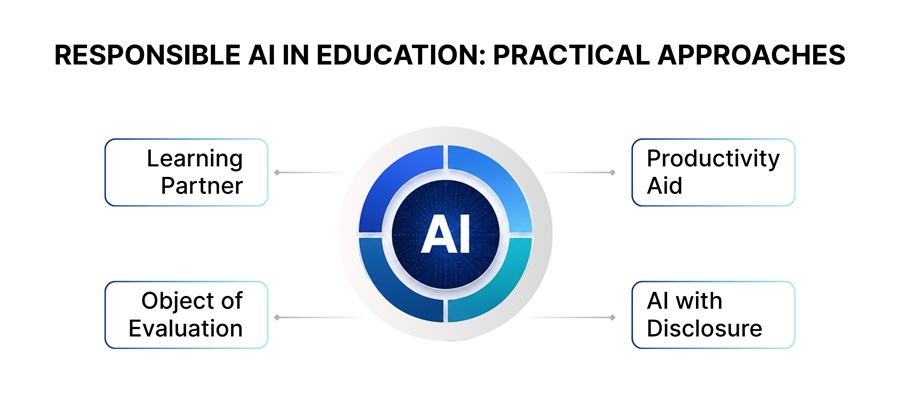
- Learning partner: Students can use AI to ask follow-up questions, explore alternative explanations, practice concepts, or receive feedback before producing their own work.
- Productivity aid: Routine tasks such as organizing notes, generating outlines, or improving grammar can be supported where they do not replace the core learning objective.
- Object of evaluation: Students can critique AI-generated responses, identify inaccuracies, examine bias, or compare machine-generated reasoning with credible sources.
- AI with disclosure: Where AI contributes meaningfully to an assignment, students can describe how it was used. This makes the process more transparent without treating every use as misconduct.
The goal is to make the learning purpose visible.
Beyond AI Detection: Rethinking Assessment and Academic Integrity
A common response to generative AI is to focus heavily on detection. However, detection cannot be the entire integrity strategy.
AI-generated content can be difficult to distinguish reliably from human writing, particularly as models improve, and students edit or combine outputs. There is also a risk of treating a detection score as definitive evidence of misconduct when it may only indicate that further review is warranted.
An assessment system built around catching AI use can also become a contest between institutions and students, doing little to develop the judgment students will need after graduation.
Assessment therefore needs greater emphasis on evidence of learning, such as drafts, reflections, oral discussions, project work, demonstrations, problem-solving processes, or assignments connected to specific experiences.
Building AI Literacy Alongside Academic Integrity
Responsible AI policies work best when students understand the reasoning behind them. Simply telling students what they cannot do is unlikely to prepare them for workplaces where AI use will be increasingly common.
Students need practical guidance on evaluating AI outputs, checking sources, recognizing bias, protecting personal information, understanding intellectual property, and deciding when AI assistance is appropriate.
The need is evident in student perceptions. The EDUCAUSE 2025 Students and Technology Report states that 55% of students see generative AI as important for their future careers, while only 20% have received meaningful institutional training.
If institutions expect responsible AI use, they also need to teach what responsible use involves.
Creating Consistent AI Policies Across Higher Education
Students should not have to interpret completely different AI rules for every course. Academic departments can retain discipline-specific requirements, but institutions can establish a common foundation around disclosure, verification, privacy, assessment expectations, and acceptable assistance.
Policy should also be revisited regularly because AI tools change quickly. Faculty development matters just as much, particularly in redesigning assessments and helping educators distinguish legitimate assistance from work that no longer represents the learner's own contribution.
There is already movement in this direction. A 2025 global survey of higher education institutions by UNESCO found that 19% had a formal AI policy, while another 42% were developing AI guidance.
The goal is consistency without unnecessary rigidity.
Balancing AI Innovation with Academic Integrity
The debate around AI in education is sometimes framed as a choice between embracing innovation and protecting academic standards. That framing is too narrow.
Used thoughtfully, AI can create opportunities for practice, feedback, accessibility, exploration, and personalized support. Academic integrity provides the boundaries that help ensure these opportunities remain connected to genuine learning.
The real task is to decide what educational purpose AI serves, what risks accompany its use, and where human responsibility must remain.
Also Read: Automation, Artificial Intelligence, and the Future of Human-Centered Education
Conclusion
Responsible AI in education will not be achieved through technology alone, nor through policies built entirely around restriction. It requires a shared understanding of what students are meant to learn and how AI can support that learning without taking over the work that makes education valuable.
Latest
Trends blogs
- Skills and the Future of Work: How Employer Expectations Are Changing
- The Changing Role of Technology in Education: From Digital Classrooms to AI
- Preparing Universities for the AI Era: A Guide for Institutional Leaders
- The Future of AI Education: How Universities Are Equipping Students for Success
Focus blogs