


Building AI Literacy and Workforce Skills in Higher Education

Artificial intelligence has moved beyond being a distant innovation in higher education; it is actively reshaping what students learn, how they learn, and what they are expected to do after graduation. Across industries like finance, healthcare, marketing, logistics, and design, AI systems increasingly influence decision-making and workplace processes, creating a growing demand for graduates who combine subject knowledge with strong AI literacy and practical digital skills.
AI literacy goes beyond technical understanding and focuses on the ability to use, evaluate, and work effectively with AI systems, making it relevant for students across all disciplines, not just computer science. Alongside this, essential workforce skills such as data interpretation, critical thinking, digital collaboration, and ethical awareness are becoming increasingly important. As a result, higher education institutions are being pushed to rethink curricula and teaching approaches to better prepare students for an AI-driven economy.
Understanding AI Literacy in the Modern Learning Context
AI literacy is not just about learning how algorithms work. It involves developing a broader understanding of how AI systems influence information, decision-making, and productivity in real-world settings. Students are expected to understand both the capabilities and limitations of AI tools, including issues such as bias, accuracy, and responsible use.
A recent 2025 research study published by Frontiers highlights that learners with structured exposure to AI concepts demonstrate significantly higher adaptability when transitioning into technology-driven workplaces.
This reflects a key shift in higher education, where AI literacy is becoming as fundamental as traditional digital literacy once was. Students are no longer just users of technology; they are expected to critically engage with intelligent systems and integrate them into problem-solving processes.
Why AI Competencies Matter for Future Careers
The modern job market is being reshaped by automation and intelligent systems. Routine tasks are increasingly handled by machines, while human roles are shifting toward creativity, strategy, interpretation, and decision-making.
A global workforce analysis shared by the World Economic Forum indicates that a significant portion of emerging job roles now require some level of AI interaction or data-based decision-making capability. While exact percentages vary across industries, the overall trend clearly shows that AI-related competencies are becoming essential instead of optional.
This means that students who graduate without exposure to AI tools and concepts may face difficulty in adapting to modern workplace expectations. Employers are increasingly prioritizing candidates who can combine domain knowledge with AI-supported analytical and problem-solving skills.
Core Components of AI Literacy in Higher Education
AI literacy draws on several interconnected skills and competencies. Higher education institutions need to ensure students develop these foundational components:
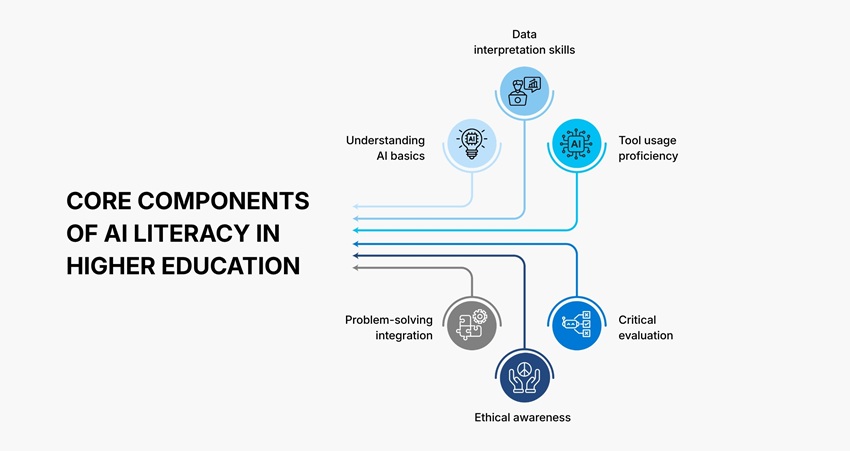
- Understanding AI basics: Awareness of how AI systems function, including machine learning, automation, and data-driven decision-making.
- Data interpretation skills: Ability to read, analyze, and draw insights from structured and unstructured data.
- Tool usage proficiency: Hands-on experience with AI-powered applications used in industry settings.
- Critical evaluation: Assessing the accuracy, bias, and reliability of AI-generated outputs.
- Ethical awareness: Understanding responsible use of AI, including privacy, fairness, and transparency concerns.
- Problem-solving integration: Applying AI tools to solve real-world academic and professional challenges.
Together, these competencies ensure that learners are not just technologically aware but also capable of applying AI meaningfully in different contexts.
Workforce Skills Aligned with AI-Driven Economies
Beyond technical AI literacy, students also need broader workforce skills to succeed in modern industries. These include communication, adaptability, critical thinking, and collaboration.
The Educause synthesis report on future educational competencies notes that hybrid skill sets combining technical knowledge with human-centered abilities are becoming the strongest predictor of employability in AI-influenced roles.
Key workforce skills include:
- Analytical thinking: Interpreting AI-generated insights effectively
- Adaptability: Adjusting to rapidly evolving technologies
- Collaboration: Working alongside AI systems and diverse teams
- Digital communication: Using digital platforms for professional interaction
- Ethical reasoning: Making responsible decisions when using AI outputs
These skills ensure that graduates are not only technically capable but also professionally adaptable.
Strategies for Building AI Competencies in Higher Education
Building AI competencies in higher education requires a structured blend of curriculum integration,
hands-on learning, and continuous exposure to real-world AI applications.
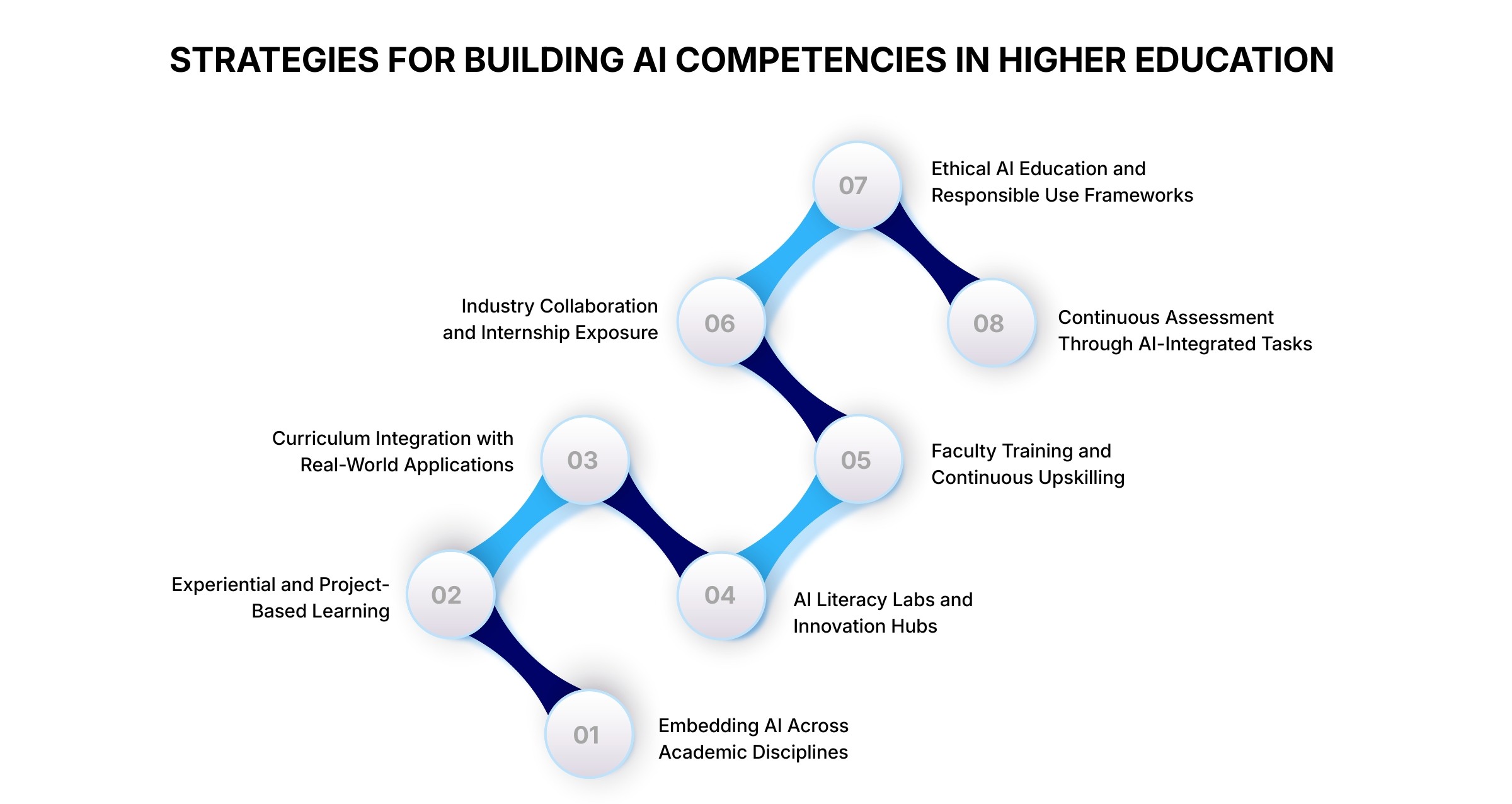
- 1. Embedding AI Across Academic Disciplines
AI education is most effective when integrated across all fields rather than restricted to computer science programs. Business students can explore predictive analytics, humanities students can use AI for content analysis, and healthcare students can learn AI-supported diagnostics.
This interdisciplinary approach ensures that AI literacy becomes a universal skill rather than a specialized niche.
- 2. Experiential and Project-Based Learning
Hands-on learning is essential for developing AI competencies. Institutions are increasingly adopting project-based models where students solve real-world problems using AI tools such as forecasting models, recommendation systems, or data visualization platforms.
This approach strengthens conceptual understanding while building workplace-ready skills.
Also Read: Reimagining Project-Based Learning in the Age of AI
- 3. Curriculum Integration with Real-World Applications
Instead of treating AI as an isolated subject, institutions are integrating it into core subjects. Assignments increasingly require students to use AI tools for research, analysis, or presentation tasks.
This helps bridge the gap between theoretical knowledge and practical application.
- 4. AI Literacy Labs and Innovation Hubs
Dedicated learning spaces such as AI labs, digital innovation centers, and simulation environments allow students to experiment with real datasets and tools. These spaces encourage experimentation, collaboration, and applied learning.
They also help students understand how AI systems behave in controlled environments before applying them in real-world contexts.
- 5. Faculty Training and Continuous Upskilling
Educators play a critical role in AI adoption. Without adequate training, even the best-designed curricula may fail to deliver impact. Institutions must invest in continuous professional development programs that help educators understand AI tools, classroom integration methods, and ethical considerations.
A 2024 synthesis report on future competencies highlights that educator readiness is one of the strongest factors influencing successful AI integration in learning environments.
- 6. Industry Collaboration and Internship Exposure
Partnerships with industries help students gain real-world exposure to AI-driven workflows. Internships, live projects, and corporate collaborations ensure that students understand how AI is applied in professional environments.
This exposure also helps align academic learning with evolving market expectations.
- 7. Ethical AI Education and Responsible Use Frameworks
As AI becomes more powerful, ethical understanding becomes essential. Students must be trained to recognize bias in algorithms, understand data privacy concerns, and ensure responsible use of
AI-generated content.
Ethical literacy ensures that AI is used as a support system while avoiding dependence on it as a blind decision-making authority.
- 8. Continuous Assessment Through AI-Integrated Tasks
AI competencies extend beyond what traditional exams can effectively measure. Institutions are adopting continuous assessment models where students are evaluated through projects, simulations, and AI-assisted problem-solving tasks.
This approach ensures that evaluation reflects real-world application through practical demonstration of skills and knowledge.
Challenges in Implementing AI Literacy in Education
Despite growing awareness, several challenges slow down the integration of AI literacy in higher education.
Many institutions face limitations in infrastructure, faculty training, and curriculum flexibility. In some cases, there is also hesitation in adopting AI tools due to concerns about academic integrity and
over-dependence on automation.
Additionally, the rapid pace of technological change makes it difficult for academic curricula to stay fully updated. What is relevant today may require revision within a short span of time.
Addressing these challenges requires continuous curriculum updates, investment in faculty development, and a balanced approach that encourages responsible AI use rather than restriction.
The Role of Educators in AI Skill Development
Educators play a central role in shaping how effectively students develop AI competencies. Their responsibility is evolving from traditional teaching to facilitation, guidance, and mentorship in
technology-integrated learning environments.
Teachers are now expected to:
- Guide students in evaluating AI-generated information
- Encourage ethical and responsible use of technology
- Design assignments that integrate AI tools meaningfully
- Support critical thinking while reducing dependence on automation.
As AI becomes more common in education, continuous professional development for educators is essential to ensure they remain confident and effective in guiding students.
Conclusion
Building AI literacy and workforce skills in higher education is emerging as a critical priority for preparing students for the realities of a technology-driven economy. As artificial intelligence continues to influence industries, the ability to understand, apply, and evaluate AI systems will define future career success.
Higher education institutions must move beyond traditional teaching models and adopt more dynamic, interdisciplinary, and practical approaches to learning. By integrating AI across disciplines, focusing on experiential learning, and strengthening both technical and human-centered skills, universities can create graduates who are not only job-ready but future-ready.
Ultimately, the goal is to equip learners to work alongside artificial intelligence effectively, responsibly, and creatively, while preserving the value of human intelligence and decision-making.
Latest
Trends blogs
- Preparing Universities for the AI Era: A Guide for Institutional Leaders
- The Future of AI Education: How Universities Are Equipping Students for Success
- Building AI Literacy and Workforce Skills in Higher Education
- Intelligent Learning Systems: The Rise of Agentic AI in Higher Education
Focus blogs