


AI Literacy for School Education: A Framework for Learning
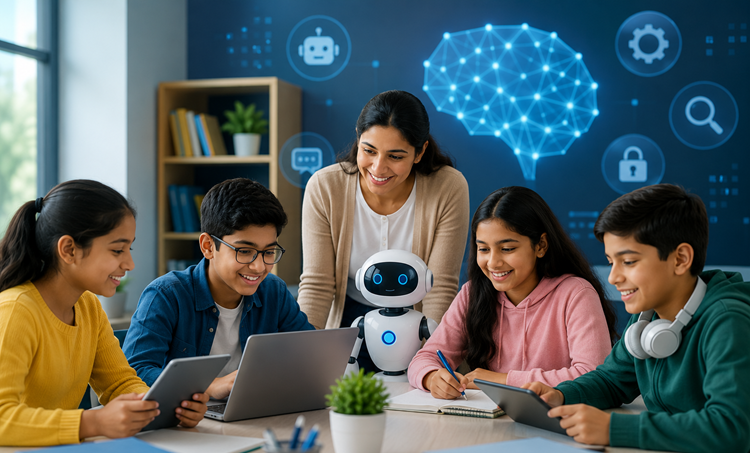
Students today encounter artificial intelligence across numerous digital learning experiences, often without realizing it. It now influences the digital platforms, educational tools, and online services that students interact with every day, making AI literacy an essential component of modern school education. As AI-powered tools become increasingly common in classrooms and daily activities, schools have a growing responsibility to help students not only use these technologies effectively but also understand how they work and engage with them responsibly.
Developing AI literacy has therefore become an essential priority in primary and secondary education. AI literacy extends beyond learning to use AI applications; it involves understanding their capabilities and limitations, critically evaluating AI-generated information, using AI ethically, and making informed decisions. By integrating these concepts across the curriculum in age-appropriate ways, schools can equip students with the knowledge, critical thinking skills, and confidence needed to thrive in an increasingly AI-driven world.
Why AI Literacy Matters in School Education
Today’s students are growing up in an environment where AI influences many aspects of daily life. Search engines prioritize information using AI algorithms, streaming platforms recommend content, navigation systems determine travel routes, and educational platforms personalize learning experiences. Although students regularly interact with these technologies, many remain unaware of how AI systems generate recommendations or make decisions.
Without AI literacy, learners may assume that AI-generated content is always accurate or unbiased. They may struggle to recognize misinformation, fabricated content, algorithmic bias, or privacy risks. AI literacy helps students develop healthy skepticism, encouraging them to verify information, compare multiple sources, and question the reliability of AI-generated outputs before accepting them as fact.
Beyond responsible technology use, AI literacy also supports future employability. As technologies increasingly influence industry practices, employers increasingly value individuals who can collaborate effectively with AI while demonstrating creativity, critical thinking, ethical reasoning, and problem-solving. Developing these competencies during the school years creates a strong foundation for lifelong learning and career readiness.
Understanding the Foundations of AI
Effective AI literacy begins with a basic understanding of what artificial intelligence is and how it functions. Younger learners do not need advanced technical knowledge. Instead, they should be introduced to simple concepts such as patterns, data, automation, and decision-making through engaging classroom activities and real-life examples.
As students progress through higher grades, they can explore more advanced topics, including machine learning, neural networks, data collection, and predictive algorithms. These concepts should be presented in ways that emphasize practical understanding rather than technical complexity.
Equally important is helping students recognize that AI systems do not think or understand information in the same way humans do. AI identifies patterns in data and generates responses based on those patterns. Understanding this distinction helps learners appreciate both the capabilities and the limitations of intelligent technologies.
Integrating AI Literacy Across the Curriculum
AI literacy should not be treated as an independent subject taught only in technology or computer science classes. Instead, it should become a cross-curricular competency that complements existing learning objectives.
Language classes provide opportunities to compare human-written and AI-generated content, encouraging students to evaluate writing quality, originality, and factual accuracy. Mathematics lessons can demonstrate how data influences AI predictions while introducing concepts such as probability and pattern recognition. Science subjects can explore AI applications in healthcare, environmental monitoring, and scientific discovery. Social studies can encourage discussions about ethics, privacy, misinformation, bias, and the societal implications of AI.
Art and creative subjects can also contribute by encouraging students to examine AI-generated artwork, discuss creativity, and reflect on the relationship between technology and human expression.
Integrating AI literacy across subjects enables students to understand that AI is not confined to technology alone but has implications across every discipline and aspect of society.
Essential Components of AI Literacy
Developing AI literacy requires a balanced combination of technical understanding, critical thinking, ethical awareness, and practical application. Schools should focus on several key competencies.
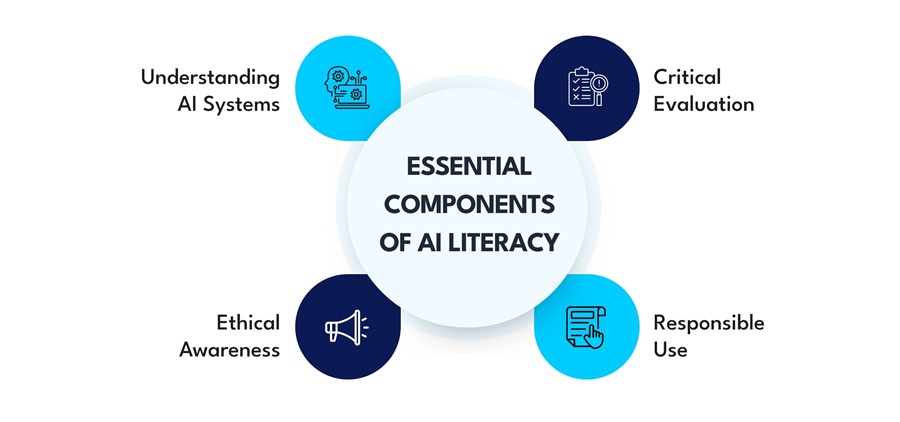
- Understanding AI Systems
Students should learn how AI systems are trained using data and why the quality of that data influences the results produced. This understanding helps learners appreciate that AI outputs depend on the information available during training.
- Critical Evaluation
One of the most valuable AI literacy skills is the ability to evaluate AI-generated information critically. Students should learn to identify factual errors, recognize incomplete information, compare different sources, and question unsupported claims.
- Ethical Awareness
AI literacy should encourage learners to consider ethical issues such as fairness, transparency, accountability, privacy, intellectual property, and responsible technology use. Students should understand that technological capability does not always justify its use.
- Responsible Use
Students should learn when AI can appropriately support learning and when independent thinking remains essential. They should also understand the importance of acknowledging AI assistance where appropriate and respecting academic integrity.
Supporting Teachers to Build AI Literacy
Teachers play a central role in successful AI literacy initiatives. Their role extends beyond introducing AI tools to helping students understand how these technologies influence learning, communication, and decision-making.
Rather than acting solely as providers of information, teachers increasingly become facilitators who encourage inquiry, discussion, and reflection. They guide students in asking thoughtful questions, evaluating AI-generated responses, and distinguishing reliable information from misleading content. The UNESCO Global Education Monitoring Report on digital education readiness found that teacher confidence in emerging technologies varies considerably across education systems, reinforcing the importance of ongoing professional development and institutional support.
To perform this role effectively, teachers require continuous professional development. As AI technologies evolve rapidly, educators need opportunities to update their knowledge, explore practical classroom applications, and develop confidence in integrating AI into teaching practices. Professional learning should also address ethical considerations, assessment strategies, and methods for promoting responsible AI use among students.
Creating AI-Ready Learning Environments in Schools
Developing AI literacy requires supportive learning environments where students can safely explore intelligent technologies while developing critical thinking skills.
Schools can strengthen AI literacy by:
- Establishing clear guidelines for responsible AI use.
- Encouraging students to question AI-generated responses rather than accepting them automatically.
- Promoting collaborative learning activities that involve discussion and reflection.
- Creating opportunities for students to solve authentic problems using AI responsibly.
- Providing equitable access to digital resources wherever possible.
- Encouraging curiosity, experimentation, and continuous learning.
Such environments help students view AI as a learning partner rather than a substitute for independent thinking.
Teaching Ethical AI Use Among Students
Ethics should be a fundamental part of AI literacy from an early stage of education. As students begin using AI-powered tools, they need to understand that these technologies have broader social implications. Topics such as privacy, bias, and misinformation should help learners recognize the importance of protecting personal information, questioning AI-generated content, and verifying information before accepting or sharing it.
Academic integrity is equally important in promoting responsible AI use. Students should view AI as a tool that supports brainstorming, research, and learning rather than replacing independent thinking or original work. By establishing clear expectations for ethical AI use, schools can encourage honesty, accountability, and responsible digital citizenship.
Assessing AI Literacy in Primary and Secondary Education
Assessment methods should evolve alongside AI literacy initiatives. Traditional examinations alone may not capture students’ ability to apply AI knowledge responsibly or think critically about intelligent technologies. A balanced assessment approach should evaluate both knowledge and application.
Effective assessment methods include:
- Project-based learning
- Digital portfolios
- Classroom discussions
- Reflective journals
- Case study analysis
- Collaborative problem-solving activities
- Presentations explaining responsible AI use
These approaches allow educators to observe how students apply AI literacy skills in meaningful contexts while encouraging deeper understanding.
Addressing the Challenges of AI Literacy Implementation
Despite growing recognition of its importance, implementing AI literacy in primary and secondary education presents several challenges.
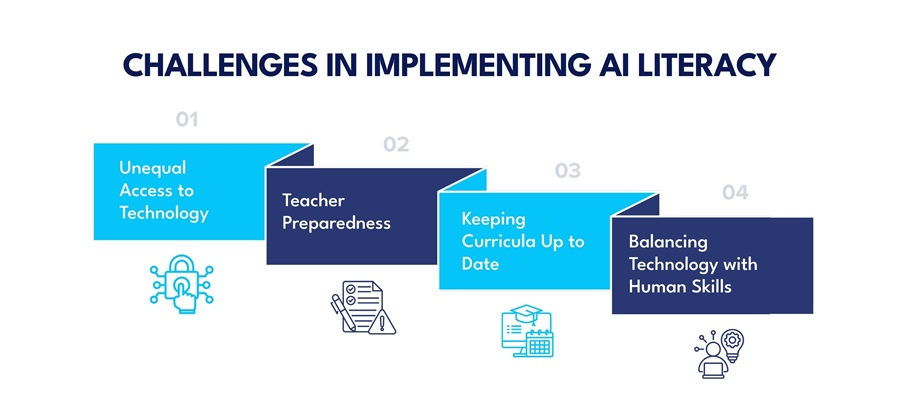
- Unequal Access to Technology: Differences in digital infrastructure, internet connectivity, and access to devices can create unequal learning opportunities, preventing some students from fully engaging with AI-related activities.
- Teacher Preparedness: Many educators are still building their understanding of AI and require ongoing professional development to integrate AI literacy confidently and effectively into classroom teaching.
- Keeping Curricula Up to Date: As AI technologies evolve rapidly, educational content can quickly become outdated. Schools need flexible curricula that emphasize enduring skills such as critical thinking, ethical reasoning, and responsible technology use.
- Balancing Technology with Human Skills: While AI can enrich learning experiences, education must continue to prioritize creativity, communication, empathy, collaboration, and independent thinking. AI literacy should complement these human capabilities rather than replace them.
Preparing Students for the Future
AI literacy prepares students for a future where intelligent technologies will play an increasingly important role in education, the workplace, and everyday life. Beyond learning how to use AI tools, students should develop the ability to evaluate AI-generated information critically, exercise sound judgment, and understand when human decision-making should take precedence.
As AI continues to evolve, schools must encourage adaptability, curiosity, and lifelong learning alongside technical knowledge. By developing these qualities, students become responsible digital citizens who can engage thoughtfully with the ethical, social, and economic implications of AI while contributing positively to their communities. According to the 2025 Flash Eurobarometer survey by OECD, 63% of respondents believe that everyone will need to be AI-literate by 2030, reflecting the growing importance of AI education in preparing future generations.
Also Read: Building AI Literacy and Workforce Skills in Higher Education
Conclusion
Artificial intelligence is reshaping education, making AI literacy an essential part of primary and secondary learning. Beyond teaching students how to use AI tools, it involves developing critical thinking, ethical awareness, responsible decision-making, and the ability to evaluate AI-generated information independently.
Successfully developing AI literacy requires collaboration among schools, teachers, and families. By integrating AI literacy across the curriculum and promoting responsible technology use, education can prepare students to become informed, adaptable, and ethical participants in an increasingly AI-driven world.
Latest
Trends blogs
- Governing AI in Higher Education: Balancing Innovation, Accountability, and Risk
- Skills and the Future of Work: How Employer Expectations Are Changing
- The Changing Role of Technology in Education: From Digital Classrooms to AI
- Preparing Universities for the AI Era: A Guide for Institutional Leaders
Focus blogs