

The Evolution of Assessment in the Age of Generative AI
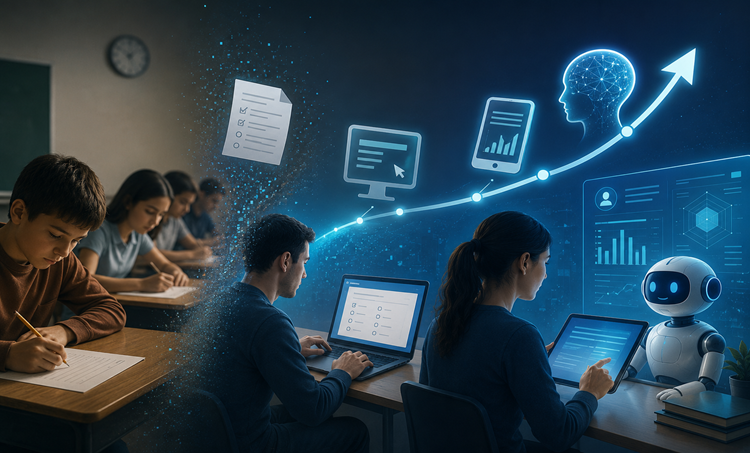
The emergence of generative artificial intelligence has transformed higher education at an unprecedented pace. What was once viewed as an experimental technology has rapidly become an everyday learning companion for students. AI-powered tools can generate essays, solve complex mathematical problems, summarize research papers, write computer code, and even provide personalized explanations within seconds. While these capabilities create exciting opportunities for learning, they also pose significant challenges for assessment, one of the most fundamental aspects of higher education.
Traditional methods of evaluation were designed for an era in which students completed assignments independently with limited technological assistance. Today, educators face a new reality where artificial intelligence can perform many of the tasks that assessments have historically measured. Consequently, institutions must reconsider whether existing evaluation methods truly reflect students' knowledge, critical thinking, creativity, and problem-solving abilities.
Assessment in the AI era is not about preventing students from using technology. Instead, it is about designing evaluation systems that encourage meaningful learning while ensuring academic integrity. The objective is to prepare graduates who can work effectively alongside AI rather than simply compete with it.
Why Traditional Assessment Is Under Pressure
Conventional assessment models have largely depended on written assignments, take-home projects, objective examinations, and standardized testing. Although these approaches have served higher education for decades, generative AI has exposed several limitations.
Students now have instant access to tools that produce polished assignments within minutes. As a result, evaluating only the final submission no longer guarantees that the learner has genuinely understood the concepts. An essay may appear well written, yet provide little evidence of the student's reasoning process or original thinking.
The rapid growth of generative AI adoption illustrates the scale of this challenge. According to a 2025 survey by UNESCO, formal AI policies were already in place at 19% of institutions, while another 42% were actively developing guidelines for AI use, demonstrating that universities worldwide recognize the urgent need to adapt their teaching and assessment practices.
Rather than attempting to eliminate generative AI from education, institutions must acknowledge that it has become a permanent part of the academic environment.
Shifting the Purpose of Assessment
Assessment has traditionally focused on measuring what students know. However, in this AI age, it must increasingly evaluate how students think, analyze information, make decisions, and solve authentic problems.
Future-oriented assessment should emphasize higher-order cognitive skills that cannot easily be replicated through automated text generation. These include critical analysis, ethical reasoning, innovation, collaboration, communication, and reflection.
Instead of asking students to reproduce information that AI can readily generate, educators should create tasks requiring learners to interpret evidence, defend their viewpoints, evaluate competing ideas, and justify their decisions using discipline-specific knowledge.
Such an approach transforms assessment from a method of testing memory into a process of demonstrating intellectual growth.
Characteristics of AI-Ready Assessment
An effective assessment framework for the AI era should incorporate multiple forms of evaluation instead of relying on a single examination or written assignment. Key characteristics include:
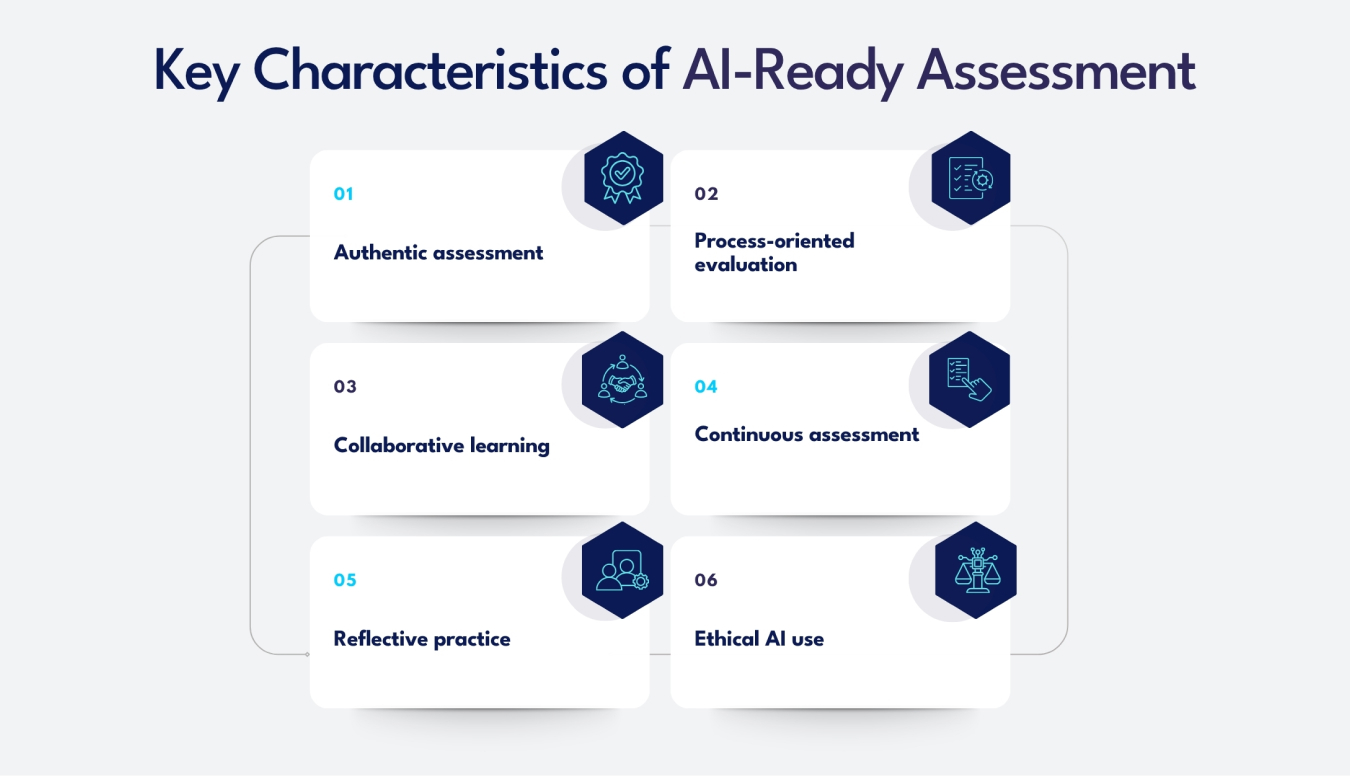
- Authentic assessment: Students work on real-world problems that require contextual understanding and practical decision-making.
- Process-oriented evaluation: Greater emphasis is placed on planning, research methods, reflection, and revision in place of only the final outcome.
- Collaborative learning: Group projects assess teamwork, leadership, and communication alongside technical competence.
- Continuous assessment: Frequent low-stakes activities provide a more comprehensive picture of learning than one final examination.
- Reflective practice: Learners explain how they approached problems, what challenges they encountered, and how they improved their work.
- Ethical AI use: Students disclose when and how AI tools have been used, encouraging transparency and responsible technology use.
These approaches reduce dependence on tasks that generative AI can complete independently while encouraging students to develop capabilities that remain uniquely human.
Redesigning Assessment Strategies
Preparing higher education for generative AI requires more than introducing new technologies. It demands thoughtful redesign of assessment itself.
Some effective strategies include:
- Replacing purely descriptive essays with case-based analysis.
- Incorporating oral presentations and viva examinations to assess conceptual understanding.
- Using portfolios that document learning over an extended period.
- Evaluating research journals and design logs alongside final submissions.
- Including peer review and self-assessment to encourage reflective learning.
- Designing interdisciplinary projects that involve solving authentic community or industry challenges.
These methods allow educators to observe not only what students produce but also how they arrive at their conclusions.
The Growing Importance of Generative AI Literacy
Assessment reform cannot succeed unless students understand how to use generative AI responsibly. AI literacy is becoming as important as digital literacy was in previous decades.
Students should learn how AI systems generate responses, recognize their limitations, verify information, identify bias, and acknowledge AI assistance appropriately. Assessment should therefore, include opportunities for learners to critique AI-generated outputs over simply accept them as accurate.
A growing body of educational research emphasizes that future graduates need competencies such as critical evaluation, metacognition, creativity, and ethical judgment to work effectively alongside intelligent technologies.
When students become informed users in preference to passive consumers of generative AI, assessment evolves into a tool for developing responsible professionals.
Also Read: Generative AI: A Catalyst for Change in Higher Education
Balancing Innovation with Academic Integrity
Academic integrity remains a central concern in the AI era. However, relying solely on AI detection software is unlikely to provide a sustainable solution. Detection systems may produce inaccurate results, while AI capabilities continue to evolve rapidly.
Instead, institutions must establish clear generative AI use policies, supported by consistent guidance for faculty and students.
A balanced integrity framework should include:
- Clear expectations regarding AI-assisted work.
- Transparent disclosure of AI use within assignments.
- Assessment tasks requiring personal reflection and justification.
- Opportunities for students to demonstrate understanding through discussion or presentation.
- Continuous faculty development on AI-enabled teaching practices.
Such measures encourage honesty without discouraging responsible technological innovation.
Challenges in Adapting Assessment for the AI Age
Despite increasing awareness, implementing AI-responsive assessment presents several practical challenges.
Faculty members require professional development to redesign assessment methods and confidently integrate generative AI into teaching. Developing authentic assessments often demands more planning, additional feedback, and revised marking criteria.
Equity also remains an important consideration. Students differ significantly in their access to AI tools, digital infrastructure, and technological skills. Institutions must ensure that assessment practices do not disadvantage learners from less privileged backgrounds.
Furthermore, maintaining consistency across departments while allowing disciplinary flexibility requires thoughtful institutional planning.
Research also highlights that confidence in using generative AI effectively remains uneven among educators. Although AI use is widespread, many higher education professionals report uncertainty about its pedagogical application and broader ethical implications, indicating that staff development remains an essential priority.
Building a Future-Ready Assessment Culture
Preparing higher education for generative AI involves a cultural shift more than a technological upgrade. Institutions should foster assessment environments that value curiosity, experimentation, ethical responsibility, and lifelong learning.
Future assessment systems are likely to become increasingly personalized, combining digital technologies with human judgment. AI itself may assist educators by generating formative feedback, identifying learning gaps, and supporting administrative tasks, allowing faculty to devote more attention to mentoring students and evaluating complex learning outcomes.
Importantly, human expertise will remain indispensable. Empathy, ethical reasoning, contextual understanding, creativity, leadership, and interpersonal communication continue to distinguish human intelligence from artificial intelligence.
Assessment should therefore measure not merely what AI can produce but what learners can uniquely contribute when working alongside intelligent systems.
Conclusion
Generative artificial intelligence has fundamentally reshaped the educational landscape, making assessment one of the most significant areas requiring transformation. Traditional evaluation methods, while valuable in the past, are no longer sufficient to measure the full range of knowledge, skills, and competencies expected of modern graduates. Higher education must move beyond assessments that reward memorization and routine content production toward approaches that emphasize critical thinking, creativity, ethical reasoning, collaboration, and authentic problem-solving.
Preparing institutions for this transition requires thoughtful policy development, faculty training, AI literacy, and assessment designs that value both the learning journey and the final outcome. In place of viewing generative AI as a threat to academic standards, educators should recognize it as an opportunity to rethink what meaningful learning truly looks like. By creating assessment systems that encourage responsible AI use while preserving human judgment and originality, higher education can equip students with the capabilities needed to thrive in an increasingly AI-driven world. Such a transformation will ensure that assessment continues to serve its primary purpose, which is not merely measuring achievement, but cultivating deeper learning, intellectual integrity, and lifelong adaptability..
Latest
Trends blogs
- Skills and the Future of Work: How Employer Expectations Are Changing
- The Changing Role of Technology in Education: From Digital Classrooms to AI
- Preparing Universities for the AI Era: A Guide for Institutional Leaders
- The Future of AI Education: How Universities Are Equipping Students for Success
Focus blogs