

Automation, Artificial Intelligence, and the Future of Human-Centered Education

Artificial Intelligence (AI) is increasingly incorporated into educational systems through applications such as automated assessment, intelligent tutoring tools, predictive analytics, and administrative support technologies. These systems are now used across classrooms, online learning platforms, and institutional operations to support instructional delivery, evaluation, and management processes. Their growing presence reflects broader efforts to improve efficiency, scalability, and access within education.
At the same time, the expanded use of AI introduces questions about how educational decisions are made and who retains control over key aspects of the learning process. Human agency in education refers to the capacity of learners and educators to exercise judgment, make informed choices, and take responsibility for learning and teaching outcomes. As AI systems increasingly influence content delivery, assessment practices, and performance interpretation, there is a need to examine how these tools affect autonomy, decision-making authority, and accountability within educational settings.
This article examines the current scope of AI applications in education, identifies observed opportunities for teaching and learning, and analyzes challenges related to decision-making, responsibility, and control. It focuses specifically on how AI systems interact with human agency at the level of instructional practice, assessment, and governance, rather than on broader societal or philosophical debates about technology. The discussion aims to clarify design and policy considerations necessary for integrating AI in ways that support, rather than displace, human judgment in education.
The Current Scope of AI in Education
AI technologies have entered educational settings in various forms, from intelligent tutoring systems and chatbots to predictive analytics and automated assessments. These tools promise customized learning pathways based on student performance, immediate feedback, and support beyond human limitations. For example, Adaptive learning technologies can dynamically adjust content, pace, and delivery based on real-time feedback from student interactions, and a study by MDPI have shown that this adaptive adjustment correlates with higher student engagement by addressing individual learning needs directly in the learning process.
Data from multiple surveys show that generative AI and intelligent tools are increasingly common among students and educators. Recent aggregated trend analysis indicates that around 78% of students now use AI tools for study and homework support. In higher education, the use of generative AI for learning tasks, research, and content summarization has become widespread, reflecting a shift in how students approach academic work.
Teachers, too, are adopting AI for instructional and administrative purposes, with many integrating analytics to monitor student progress and improve outcomes. These technologies can reduce the time spent on repetitive administrative tasks and offer detailed insights into student learning patterns. However, the very automation that enhances efficiency also highlights the central issue at stake: who remains in control of the educational experience and the decisions that shape learning?
Together, these developments illustrate how AI has become an integral part of contemporary education, setting the stage for a closer examination of the opportunities it presents for teaching and learning.
AI-Driven Advancements in Teaching and Learning
AI’s rapid evolution offers several significant opportunities for teaching and learning.
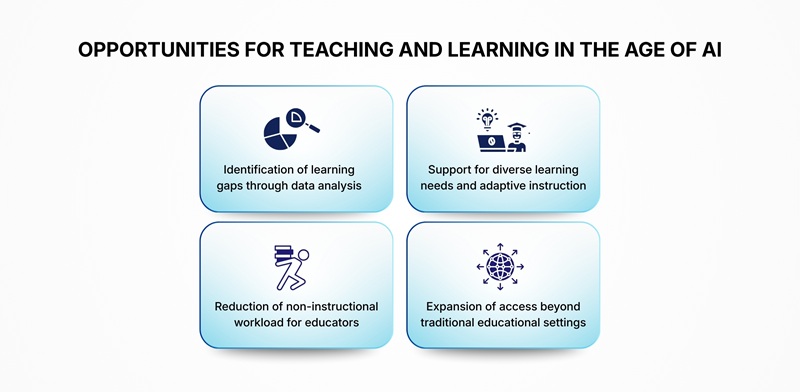
- Identification of learning gaps through data analysis
AI tools can be used to analyze large volumes of student data to surface patterns that may be difficult to detect through conventional methods alone. In practice, such systems can assist educators in identifying learning gaps and areas where students experience persistent difficulty. Predictive analytics, for instance, are often used to flag learners who may require additional academic support, allowing educators to consider timely interventions within existing instructional frameworks.
- Support for diverse learning needs and adaptive instruction
AI-based systems are frequently applied to adjust instructional pacing and content presentation in response to learner interaction. For students with learning differences or language barriers, adaptive features can modify format, sequencing, or feedback mechanisms to better align with individual needs. Interactive platforms that provide real-time feedback enable learners to revise and refine their responses, supporting iterative engagement rather than one-time evaluation.
- Reduction of non-instructional workload for educators
Automation is commonly employed to manage routine administrative functions within educational institutions. Tasks such as attendance recording, grading of objective assessments, and standardized content preparation can be partially automated, reducing time spent on repetitive processes. This redistribution of workload allows educators to focus more directly on instructional planning, student interaction, and activities that require contextual judgment.
- Expansion of access beyond traditional educational settings
AI-enabled platforms are often used to deliver instructional support outside conventional classroom environments. Virtual tutors and online learning systems can supplement educational provision in remote or under-resourced contexts, where access to trained educators may be limited. While such systems do not eliminate structural inequalities, their deployment can mitigate certain barriers related to geography, scheduling, and resource availability.
Challenges and Risks to Human Agency
Despite compelling advantages, AI integration in education raises significant concerns about human agency and autonomy.
- Influence of AI on educational decision-making processes
AI increasingly shapes educational decision-making by determining learning recommendations, performance indicators, and instructional priorities through algorithmic analysis. As these systems process large volumes of educational data to generate predictions and suggestions, they can implicitly influence how educators interpret student ability and progress. Decision-making may gradually shift from reflective, context-sensitive judgment to acceptance of system-generated outputs, particularly when AI recommendations are perceived as objective or data-driven. This dynamic can narrow the range of pedagogical choices available to educators and reduce opportunities for discretionary intervention, thereby placing greater control over educational direction in automated processes rather than human deliberation.
- Control and equity concerns in data-driven educational systems
AI-driven educational tools function through continuous collection and analysis of learner data, including performance patterns, engagement levels, and interaction behaviors. While this data enables system responsiveness, it also concentrates decision-making power within automated models. If these systems are built on incomplete or uneven datasets, the resulting decisions may systematically disadvantage certain learners. Biased inputs can influence automated recommendations and learning trajectories. When control over instructional direction shifts from educators to opaque systems, the ability to intervene, question outcomes, or correct disparities becomes limited.
- Obscuring responsibility and accountability
The growing role of AI in generating assessments, feedback, and adaptive content complicates questions of responsibility. When educational outcomes are influenced by automated decisions, it becomes difficult to determine whether accountability rests with educators, system designers, or institutions. Without clear governance structures, educators may feel compelled to accept AI-generated outputs without fully understanding how decisions are produced. Unclear accountability frameworks can also weaken professional agency and decision ownership.
- Implications for assessment control and authentic evaluation
AI-assisted academic work also affects control over assessment processes. As students increasingly use AI tools to support assignments, the boundary between independent learning and automated assistance becomes less distinct. This challenges educators’ ability to evaluate genuine understanding and skill development. When assessment decisions are influenced by tools students do not fully control or understand, the credibility of evaluation and learner agency in demonstrating competence are both diminished.
These challenges highlight a central tension in AI-enabled education: how educational systems can benefit from automated capabilities while ensuring that decision-making authority, responsibility, and control remain firmly grounded in human judgment, professional expertise, and meaningful learner participation.
Preserving Human Agency in an Automated Educational World
As artificial intelligence becomes increasingly embedded in educational systems, preserving human agency has emerged as a central challenge in ensuring that automation enhances rather than diminishes meaningful teaching and learning.
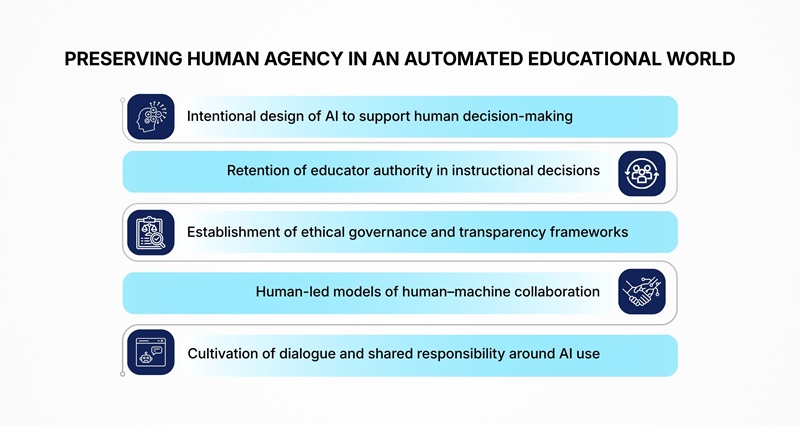
- Intentional design of AI to support human decision-making
Preserving human agency requires that AI systems in education be deliberately designed as decision-support tools rather than decision-making authorities. Educational platforms should incorporate features that allow educators and learners to review, question, and modify AI-generated recommendations. Curricula should include structured digital literacy components that explain how AI systems generate outputs, what data they rely on, and where their limitations lie. When learners understand the mechanics and constraints of AI tools, they are better positioned to use them selectively and critically, rather than defaulting to automated outputs as authoritative answers.
- Retention of educator authority in instructional decisions
Educators must retain formal authority over instructional planning, assessment interpretation, and pedagogical adjustments. AI-generated insights should be presented as advisory inputs within existing teaching workflows, not as prescriptive directives. Institutional policies can reinforce this by clearly defining that final instructional decisions rest with educators, even when AI analytics are used to inform those decisions. Maintaining educator involvement in contextualizing data and adapting learning activities ensures that professional judgment, classroom context, and learner diversity remain central to instructional control.
- Establishment of ethical governance and transparency frameworks
Operational governance frameworks are necessary to regulate how AI systems function within educational institutions. These frameworks should specify standards for data collection, access, storage, and use, along with clear protocols for consent and oversight. Transparency mechanisms, such as documented system logic, audit trails, and explainability requirements enable educators and administrators to understand how AI-driven outcomes are produced. Such measures support accountability and ensure that system behavior can be reviewed, challenged, and corrected when necessary.
- Human-led models of human–machine collaboration
Human–machine collaboration in education should be structured so that AI systems require active human validation at critical decision points. This can be achieved through interface designs that prompt educators to confirm, adjust, or reject AI-generated recommendations before implementation. Workflow integration should prioritize human review, ensuring that automated processes augment efficiency without displacing reflective judgment. By embedding checkpoints for human intervention, institutions can maintain control over how and when AI influences educational outcomes.
- Cultivation of dialogue and shared responsibility around AI use
Educational institutions should formalize channels for ongoing dialogue among educators, learners, and administrators regarding the use of AI systems. Regular review processes, feedback mechanisms, and policy evaluations allow stakeholders to identify unintended effects and adjust system use accordingly. Treating AI governance as an evolving institutional responsibility, rather than a one-time policy decision, helps align system behavior with educational goals while maintaining shared accountability across all levels of implementation.
Interested in more EdTech and higher education insights?
Sign up for our newsletter to receive the latest on EdTech advancements, AI in learning, and global higher education trends.
Subscribe NowConclusion
Artificial Intelligence will continue to transform education, offering unprecedented possibilities for enhancing learning and expanding access. At the same time, maximizing these benefits without diminishing human agency requires intentional design and ethical stewardship. Learners must be empowered to make informed decisions about their education, and educators must retain authority over instructional choices, interpretation of AI insights, and the cultivation of critical thought.
Human agency is not an impediment to automation, it is the foundation of meaningful learning. The goal of education, in both theory and practice, is not merely to transfer information but to nurture reflective, creative, and autonomous individuals. By embedding AI thoughtfully and ethically, educational systems can ensure that technology enhances human potential rather than constraining it.
The challenge ahead is not to resist automation, but to shape it in ways that reinforce human judgment, creativity, and moral purpose. In doing so, we honor the true spirit of education in a world of rapid technological change.
Latest
Trends blogs
- Governing AI in Higher Education: Balancing Innovation, Accountability, and Risk
- Skills and the Future of Work: How Employer Expectations Are Changing
- The Changing Role of Technology in Education: From Digital Classrooms to AI
- Preparing Universities for the AI Era: A Guide for Institutional Leaders
Focus blogs