


From Vision to Impact: Closing the Gender Gap in STEM Education

Across education systems, participation in STEM is increasingly evaluated through measurable outcomes. Enrollment figures alone no longer provide a complete view of progress. Institutions are expected to demonstrate that learners develop verified capabilities, remain engaged through their studies, and transition successfully into professional roles. Representation at entry levels has grown in many regions, yet disparities persist across technical disciplines, early careers, and leadership positions. These gaps point to issues in preparation, exposure, and progression pathways. The 2026 International Day of Women and Girls in Science, themed From vision to impact, highlights the need for practical, system-level action
Participation Patterns Across the Pipeline
Outreach initiatives, scholarships, and targeted admissions have expanded women’s entry into STEM education. Women now account for roughly one-third of STEM graduates globally, about 35 percent. Representation is stronger in life and physical sciences, while engineering and computing continue to show lower participation across most regions.
Academic performance does not explain this difference. Achievement levels in mathematics and science remain comparable. Subject selection, early exposure, and career guidance play a stronger role in shaping participation trends. Entry into programs is only one stage of the pipeline. Continuity through graduation and into employment requires additional structural support.
Preparation and Applied Learning
Program design influences whether learners build confidence and practical competence.
Laboratory practice, project-based assignments, and supervised industry experience connect theoretical learning with real-world application. These environments develop familiarity with professional tools and expectations. Students gain clearer understanding of potential roles and career pathways, which supports persistence and completion.
Institutions that integrate applied learning throughout the curriculum typically see stronger alignment between education and employment outcomes.
Capability and Standards
STEM roles require demonstrable technical and analytical skills. Employers rely on clear evidence of competence.
Competency frameworks, standardized assessments, and recognized credentials establish consistent benchmarks across institutions. Transparent criteria support predictable progression and reduce subjectivity in evaluation. Advancement based on verified performance strengthens both quality assurance and fairness.
Clearly defined standards help ensure that preparation translates into professional readiness.
Education–Industry Alignment
The transition from education into employment represents a critical phase. Workforce data shows that women make up approximately 28 percent of the STEM workforce across many advanced economies. This gap between graduation and workforce presence signals the need for stronger alignment.
Partnerships with employers provide practical exposure and inform curriculum design. Internships, apprenticeships, and collaborative projects allow learners to operate in professional settings and understand role expectations. Graduates enter positions with relevant experience and defined competencies.
Coordination between institutions and industry supports smoother entry into the workforce.
Retention and Career Progression
Participation challenges continue beyond hiring. Attrition during the first decade of employment remains significant. Research indicates that around 40 percent of women leave technical roles within five to seven years, compared with roughly 23 percent of men. Workplace culture, limited advancement pathways, and compensation inequities frequently contribute to these exits.
Structured progression systems support longer-term engagement. Continuing education, advanced credentials, and leadership development programs enable professionals to expand responsibilities over time. Transparent promotion criteria reinforce merit-based growth.
Leadership representation reflects the stability and maturity of the overall ecosystem.
Measuring Outcomes That Matter
Participation counts provide only a partial perspective. Institutions benefit from indicators that reflect sustained contribution.
Completion rates, credential attainment, internship conversion, employment placement, pay equity, and advancement patterns offer clearer insight into effectiveness. These measures evaluate whether preparation leads to lasting professional engagement and inform continuous improvement.
Measurement connects strategy with evidence.
Conclusion
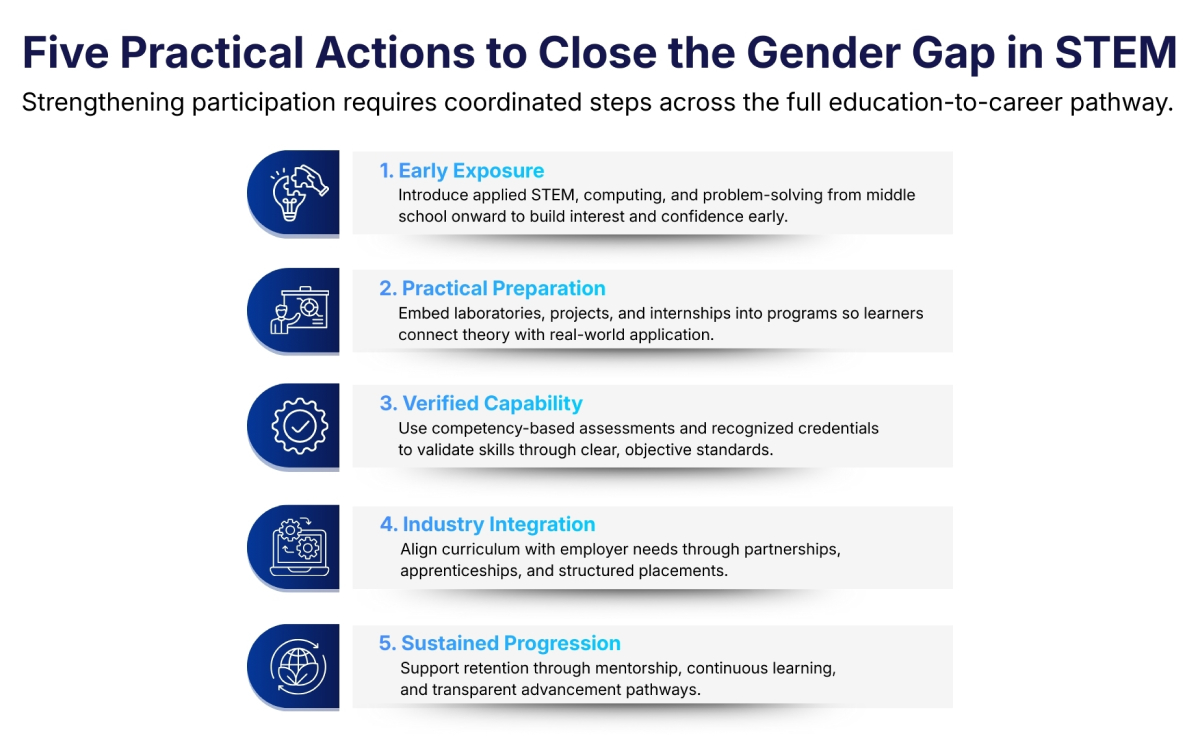
Closing the gender gap in STEM depends on deliberate system design. Early exposure, applied preparation, objective assessment, industry collaboration, and structured progression form a continuous pathway from education to leadership. Each stage reinforces the next and supports sustained participation across the talent pipeline. The theme of this year’s International Day of Women and Girls in Science, From vision to impact, reflects this focus on execution and accountability. Consistent implementation strengthens the talent base, supports innovation, and improves the effectiveness of education systems worldwide.
Latest
Trends blogs
- The Changing Role of Technology in Education: From Digital Classrooms to AI
- Preparing Universities for the AI Era: A Guide for Institutional Leaders
- The Future of AI Education: How Universities Are Equipping Students for Success
- Building AI Literacy and Workforce Skills in Higher Education
Focus blogs