

Beyond Graduation: The Importance of Lifelong Learning in Higher Education

As industries evolve at unprecedented speed and new technologies reshape the way we work and live, the ability to learn continuously has become a defining skill. Higher education is no longer just about earning a degree, it’s about creating pathways for ongoing growth, curiosity, and adaptability that equip individuals to thrive in a dynamic and unpredictable future. Lifelong learning is now at the heart of staying relevant and resilient. Institutions play a critical role in this shift, offering flexible programs, modular credentials, and access to resources that support learning at every stage of life. By upholding continuous education, learners can reinvent themselves, explore new interests, and respond effectively to the challenges and opportunities of tomorrow.
Why Lifelong Learning Matters in Higher Education
Several global trends make lifelong learning essential. Rapid automation and digital transformation shorten the useful lifespan of many skills. One report estimated that more than half of all workers will need reskilling in the near future. Meanwhile, higher education institutions have a unique role, they are not only knowledge repositories but also community hubs and innovation centres. As learners’ pathways become less linear, with many switching careers, industries, or roles multiple times, the single-degree model is giving way to a continuum of learning throughout life. In this context, higher education cannot remain static. Rather, it must provide frameworks, access routes and credentials that support learning beyond the traditional undergraduate or postgraduate period.
How Higher Education Drives the Benefits of Lifelong Learning
Lifelong learning benefits both individuals seeking to enhance their skills and employability, and higher education institutions aiming to stay relevant in a rapidly changing environment. This requires institutions to develop systems and learning models that make continuous education accessible even after graduation.
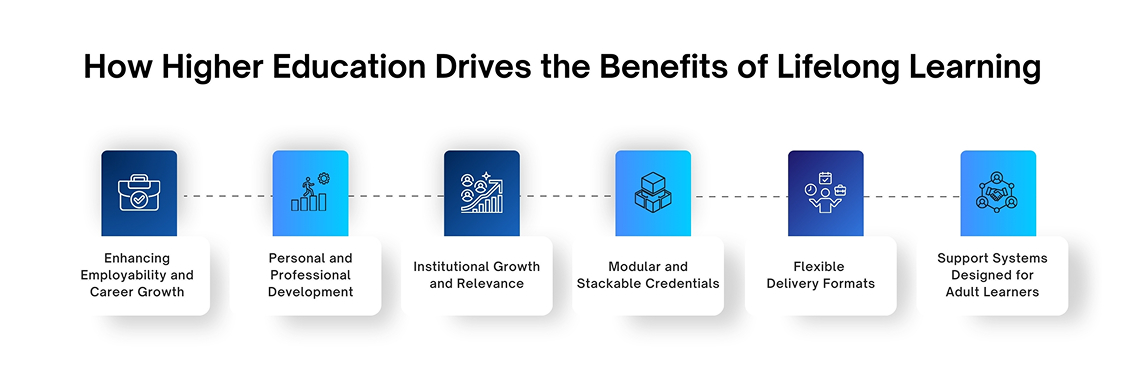
1. Enhancing Employability and Career Growth
Continuous learning strengthens an individual’s ability to navigate shifting job markets, especially as new industries grow and existing roles evolve. By updating skills regularly, learners enhance their employability and remain adaptable when career changes arise. For higher education institutions, offering short, skill-focused programmes such as certificate courses or specialization modules allows them to stay closely aligned with workforce needs and industry expectations.
2. Personal and Professional Development
Lifelong learning contributes to more than just career advancement, it enriches personal growth, confidence, and intellectual curiosity. Engaging in new learning experiences, whether academic or hobby-based, helps individuals maintain mental agility and develop new perspectives. Higher education plays a role in this by making learning more accessible beyond graduation through access to online resources, alumni learning platforms, short programmes, and opportunities to explore new interests. This creates a culture where learning becomes a continuous and fulfilling part of life, not restricted to earning a degree.
3. Institutional Growth and Relevance
Supporting lifelong learning enables institutions to evolve from degree-granting entities into continuous learning ecosystems. When they cater to different learning needs such as fresh graduates, mid-career professionals, or senior learners, they expand their reach and strengthen long-term relationships with alumni and the workforce. This approach diversifies revenue streams, helps institutions respond to future skills demand, and positions them as progressive leaders in education. By offering flexible programs and staying aligned with emerging skill requirements, institutions ensure they remain indispensable to learners throughout their professional journeys.
4. Modular and Stackable Credentials
Instead of long, rigid degree structures, modular and stackable credentials allow learners to study in smaller segments, accumulate credits over time, and progress at their own pace. This format respects the needs of working adults, parents, and busy professionals who cannot commit to full-time study. Institutions benefit by attracting a wider range of learners and enabling repeated engagement over multiple phases of a learner’s life. Through stackable learning pathways, education becomes flexible, customizable, and aligned to real-world goals without requiring learners to restart their academic journey from the beginning.
5. Flexible Delivery Formats
Flexible learning formats, such as hybrid classes, weekend batches, and online learning, remove barriers that traditionally restrict access to higher education. These models allow learners to integrate studies with employment or personal commitments. For institutions, flexibility enables broader outreach, including international learners and working professionals who previously could not attend campus-based programs. By offering different modes of delivery, institutions create opportunities for lifelong engagement and make education accessible to diverse learners regardless of location or schedule.
6. Support Systems Designed for Adult Learners
Adult learners return to education with professional experience, responsibilities, and expectations that differ from those of traditional students. Institutions can support them by offering academic guidance, career counselling, simplified admission procedures, and learning assistance. When higher education recognizes prior learning and professional experience, it encourages more adults to re-enter learning spaces with confidence. Establishing these support systems not only enhances learner satisfaction but also reinforces the institution’s commitment to lifelong learning as an ongoing partnership rather than a one-time degree experience.
Understanding the Challenges and Considerations Ahead
The shift toward lifelong learning in higher education offers significant value, but it also introduces structural, financial and cultural challenges that institutions must address to make continuous learning accessible and meaningful.
1. Institutional Priorities and Culture
Many institutions continue to focus primarily on traditional degree programmes and research responsibilities, leaving limited attention and resources for short-term or non-degree learning pathways. Lifelong learning demands a shift in mindset, universities must view alumni and adult learners as ongoing participants rather than one-time students. Without this cultural shift, lifelong learning remains an add-on instead of becoming part of the institution’s core identity.
2. Financial Barriers for Adult Learners
Adult learners often balance multiple responsibilities such as work, family and financial commitments. Since they may not qualify for the same forms of student support available to full-time learners, cost becomes a barrier to participation. Institutions need to consider flexible payment models, pay-per-module structures, or partnerships with employers to reduce financial pressure and enable learners to continue their education without disruption.
3. Infrastructure and Faculty Preparedness
Introducing lifelong learning requires adaptable academic systems, updated administrative processes and faculty who can engage with adult learners using contemporary teaching approaches. Faculty may need to rethink course design, assessment models and interaction methods to support learners with varied levels of experience. Without preparation and support, institutions may struggle to deliver meaningful learning experiences.
4. Credential Recognition and Industry Alignment
Learners pursue lifelong learning to improve career prospects, so credentials must be meaningful and recognized by employers. If institutions introduce certificates, micro-credentials or modular programmes without ensuring relevance to industry skill needs, these offerings will hold limited value. Collaboration with industry becomes essential, not optional, to ensure that learning leads to opportunities rather than just certificates.
5. Equity in Digital Learning
Online and hybrid learning formats increase access, but they can also widen disparities if not carefully implemented. Learners from different backgrounds may face challenges related to device access, reliable internet connectivity or digital literacy. Higher education institutions must ensure that digital transformation does not exclude those who lack resources or technological familiarity, otherwise lifelong learning remains accessible only to those already privileged.
A Future-Ready Approach to Lifelong Learning
Envision a graduate who returns to a university 10 years later, not to repeat a full degree, but to pick up a new micro-credential in data ethics, attend a weekend seminar on sustainable business, or engage in a lifelong-learning subscription model that allows access to several short programs across years. This is the future of higher education. Technology plays a supporting role, where adaptive platforms that recommend next steps, learning-experience environments that treat learners holistically, and digital communities that connect learners across their careers exist.
In this vision, degree completion is no longer the finish-line, it is the entry-point into a dynamic cycle of learning, unlearning and relearning. Learners shift from being students to being continuous participants in educational ecosystems. Institutions shift from fixed term-based models to ever-open frameworks that recognise learning at all life-stages. The skilful navigation of career transitions, emerging technologies and global challenges becomes supported by structured, institutional learning pathways.
Conclusion
The pace of change in work, technology and society demands that individuals continue to learn long after the tassel is turned. Higher education has a crucial role in enabling that journey, as a partner in lifelong skill development, as a provider of flexible pathways, and as a community of practice that spans decades rather than just semesters. By extending its reach and renewing its purpose, higher education can empower learners, support evolving careers and contribute to resilient societies. In a world where knowledge evolves continuously, education too must be continuous, and graduation must signal not an ending, but an ongoing beginning.
Latest
Trends blogs
- Skills and the Future of Work: How Employer Expectations Are Changing
- The Changing Role of Technology in Education: From Digital Classrooms to AI
- Preparing Universities for the AI Era: A Guide for Institutional Leaders
- The Future of AI Education: How Universities Are Equipping Students for Success
Focus blogs