

Embedding Social-Emotional Learning within Classroom Environments
Classroom learning is shaped not only by curriculum and instruction but also by the emotional and social conditions in which learning takes place. Students’ ability to regulate emotions, engage with peers, respond to challenges, and persist through difficulty directly influences how they participate in academic tasks. Social-emotional learning (SEL) addresses these dimensions by emphasizing skills such as self-awareness, emotional regulation, responsible decision-making, and interpersonal competence. Increasingly, attention has shifted from treating SEL as a separate instructional component to embedding it within everyday classroom environments.
Incorporating SEL involves integrating emotional and social considerations into instructional design, classroom interactions, and learning routines rather than delivering them as isolated lessons. This article examines how SEL can be meaningfully embedded within classroom environments by exploring its conceptual foundations, its role in shaping learning conditions, its connection to instructional design and classroom management, and the strategies educators use to support social-emotional development alongside academic learning.
Understanding Social-Emotional Learning in Classroom Contexts
Social-emotional learning in classroom contexts refers to the processes through which students develop the ability to understand emotions, manage behavior, interact constructively with others, and make thoughtful decisions within learning environments. These capacities are not separate from academic learning; they influence attention, motivation, collaboration, and problem-solving. When students struggle to regulate emotions or feel disconnected from their learning environment, academic engagement often declines.
In classrooms, social-emotional learning is expressed through daily interactions, expectations, and routines. How students respond to feedback, work through frustration, collaborate with peers, and interpret challenges reflects their social-emotional development. Integrating SEL means recognizing these moments as part of instruction rather than treating them as interruptions or secondary concerns. It shifts the focus from teaching social-emotional skills in isolation to supporting them through the structure and culture of classroom life.
Why Embedding SEL Matters for Learning Environments
Learning environments shape behavior and engagement long before academic content is introduced. Classrooms that provide emotional safety, clear expectations, and supportive relationships encourage participation and persistence. Conversely, environments characterized by unpredictability or excessive control can heighten stress and disengagement. Aligning social-emotional learning within classroom environments addresses these conditions by aligning emotional and social considerations with learning goals. Synthesis of empirical studies shows that SEL is linked with improved reading comprehension, vocabulary acquisition, and metacognitive awareness, through increased emotional regulation and motivation.
Social-emotional learning contributes to a sense of belonging and trust, which supports risk-taking and active participation. When students feel respected and understood, they are more likely to ask questions, collaborate, and remain engaged during challenging tasks. Implementing SEL also helps normalize mistakes as part of learning, reducing fear of failure and supporting reflective thinking. Rather than functioning as an additional responsibility, social-emotional learning becomes a means of strengthening the overall learning climate.
Also Read: Empathy Meets Innovation: Social and Emotional Learning Through Educational Technology
SEL and Instructional Design in Modern Classrooms
Instructional design plays a critical role in how social-emotional learning is experienced in classrooms. Lesson structure, pacing, and feedback influence how students perceive challenges and regulate effort. Planned lesson sequences and clear learning objectives reduce cognitive and emotional overload, allowing students to focus on meaning-making rather than uncertainty.
Instructional materials that encourage reflection, discussion, and multiple approaches to problem-solving support social awareness and self-management. Opportunities for choice within lessons can enhance autonomy and motivation, while collaborative tasks promote communication and perspective-taking. Infusing social-emotional learning into instructional design involves anticipating emotional responses to learning tasks and designing experiences that support persistence, reflection, and interaction.
Assessment practices also influence social-emotional development. When assessment is framed as an ongoing process rather than a final judgment, students are more likely to view feedback as constructive. Formative assessment embedded within instruction supports self-awareness and goal-setting, reinforcing the connection between effort, strategy, and progress.
Social-Emotional Learning in Classroom Interaction and Management
Classroom interactions are a primary context in which social-emotional learning unfolds. Teacher responses to student behavior communicate expectations, values, and emotional norms. Approaches to classroom management that emphasize understanding behavior as communication rather than defiance support emotional awareness and problem-solving.
Implementing social-emotional learning in classroom management involves establishing shared norms, modeling respectful communication, and responding to challenges with consistency and clarity. Rather than relying solely on corrective measures, educators can use reflective dialogue to help students understand the impact of their actions. Peer interactions also play a central role, as collaborative work provides opportunities to practice negotiation, empathy, and shared responsibility.
The way authority is exercised influences social-emotional development. When expectations are transparent and consequences are familiar, students are better able to regulate behavior and take responsibility for learning. Positioning SEL within classroom management aligns behavioral expectations with emotional understanding and relational accountability.
Instructional and Classroom Strategies for Adopting Social Emotional Learning
While social-emotional learning is not limited to strategies, intentional practices help translate principles into action. Effective strategies are integrated into existing instruction rather than added as separate activities.
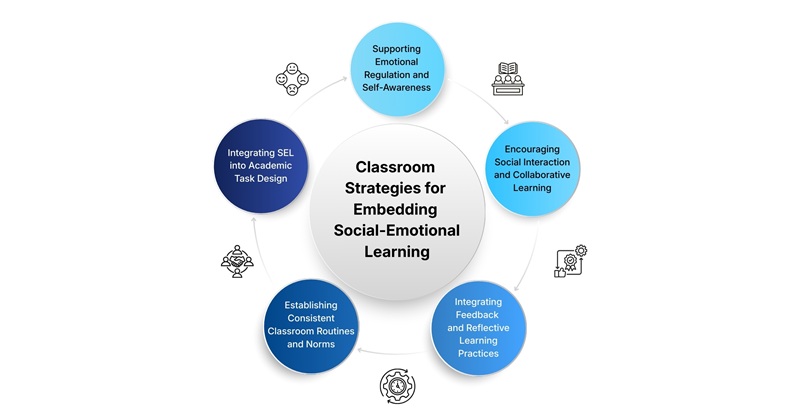
Supporting Emotional Regulation and Self-Awareness
One category of strategies supports emotional regulation and self-awareness. Brief reflective routines, such as goal-setting prompts or structured check-ins, help students recognize emotional states and prepare for learning. These practices create space for reflection without disrupting instructional flow. Research involving SEL-integrated assessment found that students who experienced SEL-aligned practices showed meaningful increases in well-being scores, indicating better emotional regulation and reduced stress.
Encouraging Social Interaction and Collaborative Learning
Structured group work with clearly defined roles encourages communication and shared responsibility. Discussion protocols that emphasize listening and respectful disagreement support perspective-taking and emotional awareness during academic tasks.
Integrating Feedback and Reflective Learning Practices
Encouraging students to evaluate their own work and learning strategies supports metacognitive awareness. Feedback that emphasizes process and effort rather than fixed ability reinforces persistence and adaptive responses to challenge.
Establishing Consistent Classroom Routines and Norms
Established routines and shared classroom norms provide emotional stability and clarity around expectations. When students understand how learning activities are structured and what behaviors are expected, they are better able to regulate their responses and focus on academic tasks. Consistent routines also reduce uncertainty, supporting emotional security and sustained engagement throughout the learning process.
Integrating SEL into Academic Task Design
Social-emotional learning can be embedded directly into the design of academic tasks rather than addressed separately. Learning activities that require collaboration, decision-making, and reflection naturally engage social-emotional competencies alongside academic skills. For example, open-ended tasks that allow multiple solution paths encourage students to manage uncertainty, negotiate ideas with peers, and persist through challenge. Operationalizing SEL at the task-design level ensures that social-emotional development occurs within authentic academic contexts rather than as an add-on. Students who participated in school-based social-emotional learning programs show statistically significant improvements in academic achievement, with an average increase of 4.2 percentile points overall, rising to 8.4 percentile points when programs run for a full academic year. These effects were found across subjects including literacy and math.
Implementation Challenges and Practical Constraints
Aligning SEL within classroom environments presents practical challenges. Time constraints, curriculum demands, and assessment pressures can limit opportunities for reflection and dialogue. Educators may also experience uncertainty about how to balance academic objectives with social-emotional considerations.
Inconsistency across classrooms can reduce the effectiveness of social-emotional learning integration. When expectations and practices vary widely, students may struggle to internalize social-emotional norms. Additionally, limited access to professional learning can affect educators’ confidence in addressing emotional and relational aspects of learning.
Addressing these challenges requires alignment between instructional goals, classroom practices, and broader educational priorities. Including SEL is not a short-term initiative but an ongoing process that requires reflection and adjustment.
Conditions for Sustainable Classroom Integration of Social-Emotional Learning
Sustainable SEL integration depends on coherence and shared understanding. Professional learning that focuses on practical application helps educators align instructional design with social-emotional goals. Reflection and collaboration support continuous improvement and responsiveness to student needs.
Consistency across learning environments strengthens the impact of embedded social-emotional learning. When students encounter similar expectations and practices, social-emotional skills are reinforced through repeated application. Family communication and shared language around learning further support coherence.
Embedding SEL within classroom environments is most effective when viewed as part of instructional quality rather than an additional responsibility. This perspective positions social-emotional development as integral to academic success.
Conclusion
Mainstreaming social-emotional learning within classroom environments enhances the conditions under which academic learning occurs. By integrating emotional awareness, social interaction, and reflective practices into instruction and classroom management, educators support student engagement, persistence, and collaboration. SEL complements academic rigor by providing foundational skills essential for effective engagement in learning.
Effective integration requires intentional instructional design, thoughtful interaction practices, and sustained reflection. When social-emotional considerations are embedded within everyday classroom experiences, learning environments become more supportive, inclusive, and responsive. Through careful implementation and ongoing refinement, SEL can strengthen both academic outcomes and the broader educational experience.
Frequently Asked Questions (FAQs)
How can teachers embed social-emotional learning into daily classroom routines?
Teachers can embed social-emotional learning by incorporating brief, intentional practices into existing routines rather than adding separate activities. Structured check-ins, goal-setting prompts at the start of lessons, and anticipated transitions help students recognize emotional states and prepare for learning. When these routines are consistently applied, social-emotional learning becomes part of the classroom rhythm rather than an additional instructional demand.
What are effective ways to integrate SEL into core subjects?
Social-emotional learning can be integrated into core subjects by aligning academic tasks with opportunities for reflection, perspective-taking, and responsible decision-making. Literature discussions can examine emotions and motivations, problem-solving activities can emphasize persistence and collaboration, and inquiry-based tasks can encourage self-regulation and communication. Embedding SEL within subject instruction allows students to develop social-emotional competencies alongside academic understanding.
How does embedded social-emotional learning affect student behavior and learning?
When social-emotional learning is embedded into classroom instruction, students often demonstrate improved engagement, emotional awareness, and self-regulation. Supportive learning environments contribute to more productive classroom interactions and reduced disruptions. Over time, students are better equipped to manage challenges, participate actively, and sustain attention during learning tasks.
What classroom practices and teaching strategies best support social-emotional learning?
Effective practices include reflective routines, structured collaborative activities, process-oriented feedback, and curriculum-integrated learning tasks that promote empathy and responsible action. These strategies are most effective when aligned with instructional goals and classroom expectations, ensuring that social-emotional learning supports academic engagement rather than competing with it.
How can schools evaluate the effectiveness of classroom-based social-emotional learning?
Schools can evaluate social-emotional learning by combining multiple indicators, such as classroom observations, student self-reflections, behavioral data, and engagement measures. Rather than relying on a single assessment, ongoing monitoring of classroom interactions and learning behaviors provides a more accurate picture of how SEL is influencing student experiences and instructional outcomes.
Latest
Trends blogs
- Skills and the Future of Work: How Employer Expectations Are Changing
- The Changing Role of Technology in Education: From Digital Classrooms to AI
- Preparing Universities for the AI Era: A Guide for Institutional Leaders
- The Future of AI Education: How Universities Are Equipping Students for Success
Focus blogs