

Generative AI as a Tool for Adaptive and Personalized Education

Generative artificial intelligence (AI) refers to a class of computational models that can produce new content, such as text, examples, quizzes, explanations, and interactive prompts, based on patterns learned from large datasets. In educational contexts, generative AI tools are being leveraged to create individualized learning interactions, offer immediate feedback, and support learners with different needs. The integration of these tools into personalized educational practices marks a shift from uniform instruction toward adaptive, responsive learning experiences.
This article examines the integration of generative AI into personalized education by exploring its practical applications, potential advantages, operational challenges, and considerations for implementation. It focuses explicitly on mechanisms through which generative AI can adapt content, support educators, and influence learning processes, while also highlighting implementation constraints and ethical considerations that affect real-world deployment.
Enhancing Higher Education with Generative AI — A Responsible Approach
Discover how AI is transforming academia while ensuring ethics, fairness, and academic integrity.
Download the whitepaper
The Conceptual Foundation of Generative AI in Education
Generative AI systems are built on large language models and pattern-recognition architectures that can generate contextually relevant content when prompted. Unlike rule-based automation, these systems model linguistic and structural relationships within educational content, enabling them to produce diverse outputs such as practice problems, explanations, dialogue scenarios, simulations, and feedback loops. Crucially, generative AI expands the range of inputs that can be dynamically synthesized in response to learner needs.
In personalized educational practices, the generative capabilities of AI are used to adjust or supplement instructional content based on learner responses and performance patterns. Through iterative prompts and adaptive content selection, generative AI can present learning materials that are more aligned with an individual’s current understanding and areas of difficulty.
Mechanisms of Personalization Enabled by Generative AI
Generative AI contributes to personalized learning through several interconnected mechanisms:
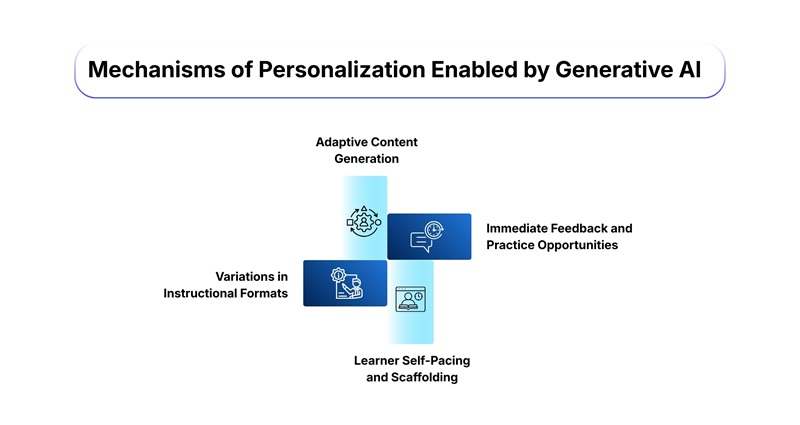
- Adaptive Content Generation
Generative AI can produce content that reflects variations in learner responses. For example, when a learner struggles with a concept, the system can generate additional examples, alternative explanations, or simplified walkthroughs. These generative outputs are based on real-time interaction data rather than static curricula. The goal is to support understanding by matching content complexity to a learner’s immediate performance.
- Immediate Feedback and Practice Opportunities
Traditional instruction often delays feedback until assignments are collected and reviewed. In contrast, generative AI systems can analyze a student’s response and produce corrective feedback instantly. This real-time analysis can enhance student engagement and self-regulated learning by enabling continuous adjustment of practice tasks. Educational research indicates that technologies designed to adapt learning materials and feedback to student needs can lead to measurable improvements in engagement and understanding when thoughtfully integrated into instructional practice.
- Variations in Instructional Formats
Different learners benefit from varied representations of learning materials. For instance, narrative examples for conceptual learners and procedural explanations for analytical learners. Generative AI can produce multiple representations of the same concept, facilitating engagement across cognitive styles and preferences.
- Learner Self-Pacing and Scaffolding
Generative AI supports self-paced progression by identifying where learners excel or struggle and generating sequence adjustments accordingly. This kind of scaffolding is evident in intelligent tutoring systems that prompt reflection, offer graduated hints, and withhold complete solutions until learners demonstrate readiness.
Instructional Design Changes Enabled by Generative AI
The integration of generative AI into personalized educational practices is influencing how instructional design is structured and implemented. Traditional linear lesson models are increasingly complemented by modular approaches in which learning activities, explanations, and assessments can be reorganized based on learner progression. Generative AI supports this flexibility by enabling the creation of instructional materials that respond to learner interaction patterns rather than fixed content sequences.
Instructional development is also becoming more dynamic in AI-supported environments. Educators can generate and review multiple versions of explanations, examples, or practice tasks before selecting those most appropriate for a given learning context. This allows teaching materials to evolve over time based on observed learner responses, reducing reliance on static instructional resources.
Generative AI is also affecting how assessment is embedded within teaching practices. Rather than serving only as an endpoint, assessment increasingly functions as an ongoing component of instruction. AI-generated formative questions and reflective prompts allow educators to gauge understanding throughout the learning process, supporting timely instructional adjustments while keeping educators responsible for final pedagogical decisions.
Benefits of Integrating Generative AI into Personalized Practices
When applied within instructional frameworks, generative AI can support personalized learning by expanding instructional flexibility, assisting educators, and enabling scalable forms of individualized academic support.
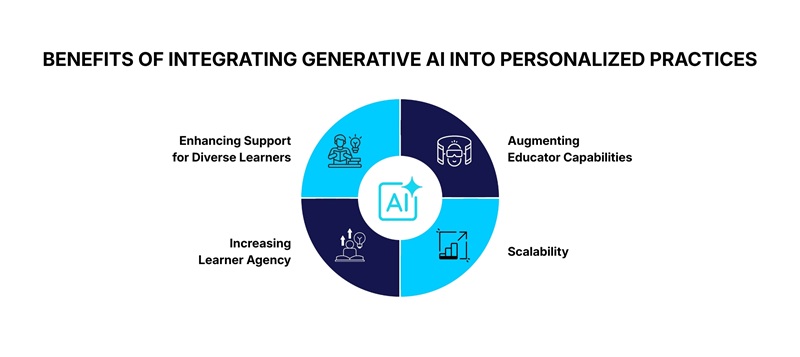
- Enhancing Support for Diverse Learners
Generative AI systems can adapt explanations and practice items to various learner needs, making them potentially useful in settings where learners have diverse background knowledge or learning preferences. By generating explanations at different levels of complexity, AI can support learners who require additional instructional support.
- Augmenting Educator Capabilities
Educators often balance content delivery with administrative demands and feedback provision. Generative AI can assist with generating practice problems, prompts for reflection, or suggested feedback structures, freeing educators to focus on interpretive and relational aspects of teaching that machines cannot replicate.
- Increasing Learner Agency
When learners can interact with generative AI systems to request clarifications or alternative examples, they may gain more control over their learning paths. This agency can contribute to greater involvement in the learning process as students explore concepts through recurrent dialogue with the system.
- Scalability
Generative AI can support large numbers of learners by producing individualized resources without requiring proportional increases in human instructional time. This scalability can be critical in settings with high enrollment or limited instructional personnel.
Challenges and Constraints in Practice
Despite potential benefits, integrating generative AI into personalized educational practices involves several practical challenges:
- 1. Data Privacy and Security
Generative AI systems often require access to student interaction data to generate relevant outputs. This dependence raises questions about data privacy, consent, and secure handling of sensitive information. Without robust data governance policies, educational institutions risk misuse or exposure of learner data.
- 2. Accuracy and Reliability of Outputs
Generative AI models may produce content that is factually incorrect, misleading, or contextually inappropriate. There are noted concerns about the inaccuracy of AI-generated content affecting learner confidence and workflow quality. These limitations necessitate ongoing human oversight and verification to ensure that educational content meets academic standards.
- 3. Algorithmic Bias
Because generative AI models are trained on existing datasets, they can reflect and reinforce biases present in those datasets. If outputs perpetuate stereotypes or unfair representations, they can undermine equitable learning. Careful dataset curation and bias-mitigation strategies are essential in deployment.
- 4. Over-Reliance and Academic Integrity
There is a risk that learners may become overly dependent on AI-generated answers or feedback, potentially diminishing opportunities for deeper cognitive processing. Educational professionals must design interactions that require active learner input and reflection, not passive acceptance of AI responses.
- 5. Infrastructure and Resource Constraints
Deploying advanced generative AI systems requires computational infrastructure, technical integration, and professional training. These resource requirements may limit equitable access, particularly in underfunded educational settings.
Operational Considerations for Implementation
Effective integration of generative AI into personalized educational practices involves several operational strategies:
- 1. Professional Development for Educators
Teachers and instructional designers should receive training on how to interpret AI outputs, guide learners in using AI constructively, and integrate human-led activities with AI-generated content.
- 2. Clear Governance and Guidelines
Institutions should establish frameworks that govern data use, consent, ethical considerations, and responsibility for content accuracy. Policies must balance innovation with protection of learner rights and academic standards.
- 3. Human-in-the-Loop Models
Generative AI should be embedded in workflows that preserve human oversight. Educators can review, refine, and validate AI-generated materials to ensure relevance and accuracy before use.
- 4. Equity and Access Planning
To avoid exacerbating the digital divide, institutions should consider equitable access to devices, connectivity, and training, ensuring that all learners benefit from personalized AI support.
Future Directions and Research Needs
Although generative AI has demonstrated utility in enhancing personalized learning interactions, more rigorous research is needed to understand its long-term effects on deep learning, critical thinking, and skill development. Future investigations should examine not only engagement metrics but also how generative AI integration influences learners’ ability to solve complex problems, collaborate meaningfully, and apply knowledge beyond specific AI interactions.
Additionally, emerging frameworks that emphasize explainability, bias detection, and human-AI collaboration will be critical in helping educational systems adopt generative AI responsibly and effectively.
Stay ahead in education, AI, and innovation.
Get Academik America’s latest insights, research, and expert perspectives delivered to your inbox.
Subscribe nowConclusion
Integrating generative AI into personalized educational practices offers a pathway to more responsive and adaptive learning environments. Through mechanisms such as real-time feedback, adaptive content generation, and dynamic scaffolding, generative AI can enhance learner engagement and support diverse educational needs. However, the realization of these benefits is contingent upon equitable access, robust governance, ethical usage, and continued human oversight.
Practical integration requires careful consideration of data privacy, accuracy, algorithmic fairness, and instructional design. When embedded thoughtfully into educational ecosystems, generative AI can augment human instructional capacities and help shape learning experiences that are both personalized and academically sound. Continued research and policy development will be essential in ensuring that generative AI enhances, not undermines, the core goals of education.
Frequently Asked Questions (FAQs)
Q. How is generative AI different from traditional educational technology?
A. Traditional educational technologies typically rely on predefined rules or fixed content pathways, offering limited flexibility once deployed. Generative AI, by contrast, can produce new instructional content in response to learner inputs, enabling more dynamic interactions such as generating explanations, examples, or feedback on demand. This capacity allows learning experiences to adapt continuously rather than follow static instructional sequences.
Q. Can generative AI replace educators in personalized learning environments?
A. Generative AI is not designed to replace educators but to function as a supplementary tool within instructional systems. While it can assist with content generation, feedback drafting, and practice creation, it lacks contextual judgment, ethical reasoning, and relational understanding. Effective personalized education depends on educator oversight to interpret learner needs, validate AI outputs, and make pedagogical decisions.
Q. How does generative AI support personalization without tracking excessive learner data?
A. Personalization can be achieved through interaction-based adaptation rather than long-term data accumulation. Many generative AI systems adjust responses based on immediate prompts, recent learner inputs, or session-level performance rather than storing identifiable learner histories. Responsible implementation requires minimizing data retention, anonymizing inputs where possible, and applying strict access controls.
Q. What risks do inaccurate or misleading AI-generated responses pose in education?
A. Inaccurate or misleading outputs can confuse learners, reinforce misconceptions, or reduce trust in instructional materials. These risks are particularly significant in subjects requiring precision or conceptual clarity. As a result, generative AI systems should be deployed with review mechanisms that allow educators to verify content and intervene when outputs do not meet academic standards.
Q. How can educators prevent learner over-reliance on generative AI?
A. Over-reliance can be mitigated through instructional design choices that require learner reasoning, reflection, and original input. Rather than presenting AI outputs as final answers, educators can frame them as prompts for analysis, comparison, or revision. Embedding AI use within inquiry-based tasks encourages learners to engage critically rather than passively accept generated content.
Q. Does generative AI support inclusive education, or can it reinforce bias?
A. Generative AI has the potential to support inclusive education by offering varied explanations and alternative representations of content. However, because models are trained on existing data, they may reflect biases present in those sources. Inclusive use depends on careful system evaluation, bias testing, and ongoing monitoring to ensure outputs do not disadvantage particular learner groups.
Q. What skills do educators need to effectively integrate generative AI?
A. Educators benefit from developing skills in prompt design, critical evaluation of AI-generated content, and ethical decision-making related to technology use. Equally important is pedagogical judgment, knowing when AI support is appropriate and when human instruction is essential. Professional learning initiatives should focus on integration strategies rather than technical complexity alone.
Latest
Trends blogs
- Skills and the Future of Work: How Employer Expectations Are Changing
- The Changing Role of Technology in Education: From Digital Classrooms to AI
- Preparing Universities for the AI Era: A Guide for Institutional Leaders
- The Future of AI Education: How Universities Are Equipping Students for Success
Focus blogs