

Intelligent Learning Systems: The Rise of Agentic AI in Higher Education

Artificial intelligence is no longer confined to supporting roles in higher education and is increasingly shaping how learning is designed, delivered, and experienced. Among the most significant developments is the emergence of agentic AI, which is a system capable of autonomous decision-making, goal-directed behavior, and continuous adaptation. Unlike earlier forms of AI that primarily assisted with isolated tasks, agentic systems can plan, act, and refine their actions in dynamic environments. This shift is redefining how students learn, how educators teach, and how institutions operate.
As universities attempt to prepare learners for an increasingly complex and digital world, intelligent learning systems powered by agentic AI are gaining prominence. These systems offer personalized education, improved engagement, and enhanced administrative efficiency. However, their rise also raises critical questions about ethics, governance, and the future role of human educators. Understanding the implications of this technological shift is essential for shaping the future of higher education.
Defining Agentic AI in Modern Education
Agentic AI refers to systems that can independently pursue goals, make context-aware decisions, and interact with users in a continuous and adaptive manner. In the context of higher education, these systems go beyond basic automation or recommendation engines. They can guide students through learning pathways, provide real-time feedback, and even anticipate challenges before they arise.
The distinction between traditional AI and agentic AI lies in autonomy and adaptability. While conventional systems rely on predefined rules or static datasets, agentic AI continuously learns from interactions and adjusts its behavior accordingly. This makes it particularly valuable in educational settings, where learning needs vary significantly across individuals.
Transforming Student Learning Experiences through Agentic AI
One of the most significant impacts of agentic AI is its ability to transform student experiences from standardized to highly personalized. Intelligent systems can analyze a student’s learning patterns, strengths, and weaknesses, and then tailor content accordingly. This level of customization was previously difficult to achieve at scale.
For instance, agentic AI can dynamically adjust the pace of instruction, recommend supplementary materials, and provide instant feedback on assignments. This reduces the time lag between learning and evaluation, enabling students to correct mistakes and deepen understanding in real time.
Moreover, these systems can support diverse learning styles by offering multiple modes of content delivery, including text, video, simulations, and interactive exercises. This flexibility enhances engagement and improves learning outcomes.
The demand for such personalized experiences is growing. A 2025 survey by ERIC found that 92% of students are now using AI tools in some form to support their learning, reflecting a strong shift toward AI-driven and adaptive learning environments. Agentic AI is uniquely positioned to meet this demand.
Enhancing Teaching and Academic Support
While much attention is given to student benefits, agentic AI also has significant implications for educators. Intelligent systems can assist with routine tasks such as grading, content organization, and administrative coordination, allowing educators to focus on more meaningful interactions with students.
More importantly, agentic AI can act as a co-instructor, providing insights into student performance and identifying areas where intervention is needed. By analyzing large volumes of data, these systems can detect patterns that may not be immediately visible to human instructors.
Agentic AI strengthens teaching and academic support by helping educators make more informed decisions and deliver more personalized learning experiences. Teachers remain essential for guiding critical thinking, fostering creativity, and providing emotional support, the areas where human interaction is irreplaceable. However, effective integration requires training and support. Educators must be equipped with the skills to interpret AI-generated insights and incorporate them into their teaching practices.
Administrative Efficiency and Institutional Transformation
Beyond the classroom, agentic AI is reshaping institutional operations. Universities manage complex systems involving admissions, scheduling, resource allocation, and student services. Agentic AI can streamline these processes by automating decision-making and optimizing resource use.
For example, intelligent systems can predict enrollment trends, allocate resources more efficiently, and personalize student support services. This leads to improved operational efficiency and better student satisfaction.
The financial implications are also significant. The AI industry report by Ellucian states that 80% of institutions adopting AI are doing so specifically to improve operational efficiency and productivity across administrative functions. This highlights how AI-driven systems are increasingly being used to streamline processes such as admissions, enrollment management, and student services, enabling institutions to operate more effectively.
Key Applications of Agentic AI in Higher Education
Agentic AI is being applied across multiple areas within higher education:
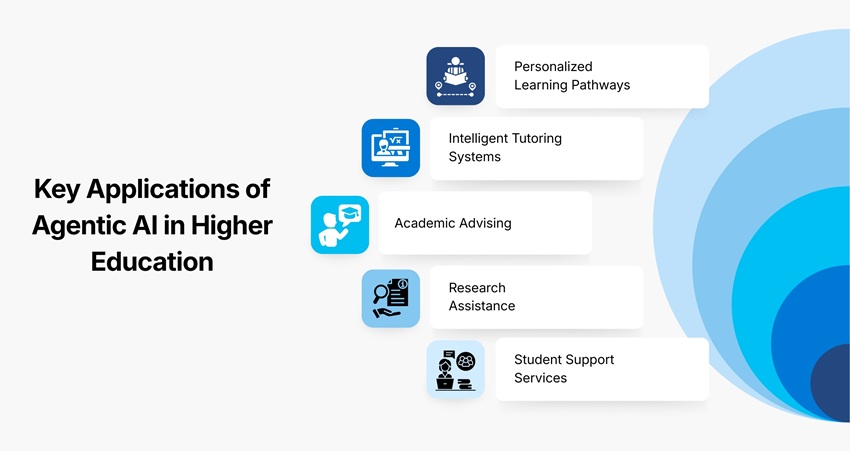
- Personalized Learning Pathways: Systems that design and adapt curricula based on individual progress
- Intelligent Tutoring Systems: AI agents that provide real-time guidance and feedback
- Academic Advising: Automated systems that help students make informed decisions about courses and careers
- Research Assistance: Tools that support literature review, data analysis, and hypothesis generation
- Student Support Services: AI-driven platforms that address queries, mental health concerns, and administrative needs
These applications demonstrate the versatility of agentic AI and its potential to enhance both academic and operational aspects of education.
Challenges and Ethical Considerations of Adopting Agentic AI
Despite its potential, the adoption of agentic AI in higher education is not without challenges. One of the primary concerns is data privacy. Intelligent systems rely on large amounts of personal data to function effectively, raising questions about how this data is collected, stored, and used.
Bias is another critical issue. If AI systems are trained on biased data, they may produce unfair or discriminatory outcomes. This can have serious implications for student evaluation and opportunities.
There is also the risk of over-reliance on technology. Excessive dependence on AI could reduce critical thinking and problem-solving skills among students. Maintaining a balance between technological assistance and independent learning is essential.
Additionally, the lack of clear regulatory frameworks makes it difficult to ensure accountability and transparency in AI-driven decision-making.
Policy and Governance Considerations
To fully realize the benefits of agentic AI, higher education institutions must develop robust policy frameworks. These policies should address issues such as data protection, ethical use of AI, and accountability mechanisms.
Governance structures must also be established to oversee the implementation and evaluation of AI systems. This includes setting standards for transparency, ensuring fairness, and monitoring outcomes.
Collaboration between policymakers, educators, and technology developers is essential for creating effective and sustainable solutions. Without coordinated efforts, the integration of agentic AI may lead to fragmented and inconsistent outcomes.
Innovative Approaches to Integration
Institutions are adopting innovative strategies to integrate agentic AI effectively:
- Pilot Programs: Testing AI systems in controlled environments before full-scale implementation
- Hybrid Models: Combining human instruction with AI-driven support systems
- Continuous Feedback Loops: Using data to refine and improve AI performance
- Digital Literacy Initiatives: Preparing students and educators to work effectively with AI technologies
These approaches emphasize adaptability and continuous improvement, which are crucial in a rapidly evolving technological landscape.
The Future of Agentic AI in Higher Education
The trajectory of agentic AI suggests that its role in higher education will continue to expand. As technology becomes more sophisticated, intelligent systems will be able to handle increasingly complex tasks, from curriculum design to research innovation.
At the same time, the human element will remain central. Education is not only about knowledge acquisition but also about developing critical thinking, creativity, and social skills. Agentic AI should be seen as a tool that enhances these processes rather than replacing them.
The future of higher education will likely involve a hybrid model, where human expertise and artificial intelligence work together to create more effective and inclusive learning environments.
Conclusion
The rise of agentic AI represents a major shift in higher education, with intelligent and adaptive systems reshaping student learning experiences, teaching practices, and institutional operations. At the same time, this transformation raises important concerns related to ethics, governance, and equitable access.
To fully benefit from agentic AI, education systems must adopt a balanced approach that includes investment in infrastructure, clear policy frameworks, and digital preparedness among educators and students. Rather than replacing human educators, agentic AI should be used to support and enhance learning, helping higher education become more personalized, inclusive, and responsive to changing needs.
Frequently Asked Questions
1. How does agentic AI improve student learning experiences?
Agentic AI enhances learning by adapting educational content to individual student needs, offering real-time feedback, and supporting multiple learning styles through interactive and adaptive tools.
2. Can agentic AI replace teachers in higher education?
No, agentic AI is designed to support rather than replace educators. Teachers remain essential for critical thinking, creativity, mentorship, and emotional support, which cannot be fully replicated by AI systems.
3. What are the main benefits of agentic AI for universities?
Agentic AI can improve administrative efficiency, streamline admissions and student services, enhance academic support, and provide personalized learning experiences that improve student engagement and outcomes.
4. What challenges are associated with adopting agentic AI in education?
Major challenges include data privacy concerns, algorithmic bias, lack of regulatory frameworks, ethical issues, and the risk of overdependence on technology in the learning process.
5. What is the future of agentic AI in higher education?
The future of agentic AI is likely to involve hybrid learning models where human educators and intelligent systems work together to create more adaptive, inclusive, and efficient educational environments.
Latest
Trends blogs
- Governing AI in Higher Education: Balancing Innovation, Accountability, and Risk
- Skills and the Future of Work: How Employer Expectations Are Changing
- The Changing Role of Technology in Education: From Digital Classrooms to AI
- Preparing Universities for the AI Era: A Guide for Institutional Leaders
Focus blogs