

Health for All - Education as a Pathway to Equitable Health Outcomes

Health equity remains a critical global priority, reflecting the goal of ensuring that every individual has a fair and just opportunity to achieve optimal health. Despite advancements in healthcare systems, disparities in health outcomes persist across populations, often shaped by social, economic, and environmental factors. Among these determinants, education serves as a foundational pillar for long-term health improvements and equity.
Education extends beyond academic achievement; it plays a vital role in shaping awareness, decision-making, and access to resources that directly influence health outcomes. Individuals with better access to education are more likely to understand health information, adopt preventive practices, and navigate healthcare systems effectively. As a result, strengthening the role of education in promoting health equity has become increasingly important in addressing disparities and improving overall well-being.
Understanding the Link Between Education and Health Outcomes
The connection between education and health is both direct and far-reaching. Educational attainment influences a wide range of factors, including income levels, employment opportunities, and living conditions, all of which contribute to overall health. Individuals with higher levels of education are more likely to secure stable employment, access better healthcare services, and maintain healthier lifestyles.
In contrast, limited access to education often correlates with lower health awareness, reduced access to healthcare, and increased exposure to health risks. These disparities highlight the importance of education as a foundational element in achieving health equity.
A study by Organisation for Economic Co-operation and Development (OECD) indicates that individuals with lower levels of education are significantly more likely to experience poor health outcomes and reduced life expectancy compared to those with higher educational attainment. This underscores the critical role education plays in shaping long-term health trajectories.
Aligning Global Health Priorities with Education-Led Equity
Global health priorities increasingly highlight the importance of collective, evidence-based action in addressing disparities. These priorities are often guided by international public health initiatives such as World Health Day, observed anually by WHO, which set global agendas and encourage countries to adopt coordinated strategies for improving health outcomes. In this context, education plays a critical role by enabling individuals and communities to engage with reliable information and make informed health decisions. The theme of World Health Day 2026, “Together for health. Stand with science,” reinforces the need for shared responsibility and scientific understanding in improving health outcomes. This aligns closely with education-driven health equity, where access to knowledge and critical thinking skills strengthens the ability to navigate complex health information.
A key dimension of this alignment is the growing importance of STEM education. By building foundational knowledge in science, technology, engineering, and mathematics, learners develop the capacity to interpret health data, understand scientific developments, and engage with innovations in healthcare. This not only enhances public understanding of health issues but also supports informed participation in health-related decisions. For instance, studies indicates that students who demonstrate higher proficiency in science are significantly more likely to apply scientific knowledge to real-life situations, including health related decision-making, highlighting the practical value of STEM learning. At the same time, expanding access to STEM education helps prepare a skilled and diverse workforce capable of contributing to healthcare systems, research, and public health initiatives.
Education also strengthens trust in scientific knowledge by equipping individuals with the ability to evaluate information critically. In an environment where misinformation can influence health behaviors, this capability becomes increasingly important. By promoting awareness grounded in credible knowledge and aligning learning with global health priorities, education contributes to more informed communities and more effective responses to health challenges, ultimately supporting equitable and sustainable health outcomes.
Expanding Access to Education as a Health Equity Strategy
Access to education functions as a structural determinant of health, shaping who has the opportunity to acquire essential knowledge and skills. Inequities in access, driven by socioeconomic conditions, geography, and infrastructure, often translate directly into disparities in health outcomes. When segments of the population are excluded from quality education, the gap in health awareness and access to resources widens, reinforcing cycles of disadvantage.
Addressing these barriers is therefore central to advancing health equity. Ensuring that education systems are inclusive and accessible creates a more level foundation, where individuals from diverse backgrounds have the opportunity to benefit from learning. This is not only about individual growth but about correcting systemic imbalances that influence population health.
At a broader level, expanding access contributes to stronger communities and more equitable social structures. It enables wider participation in public health efforts and supports the development of environments where healthier choices and resources are more evenly distributed. In this sense, access to education shapes the conditions within which health outcomes are determined.
Building Health Awareness Through Education
Education plays a crucial role in enhancing health awareness, enabling individuals to understand the importance of preventive care, nutrition, hygiene, and mental well-being. Health literacy, which refers to the ability to access, understand, and use health information, is a key component of this process.
Individuals with higher levels of health literacy are better equipped to make informed decisions about their health, seek timely medical care, and adhere to treatment plans. This not only improves individual outcomes but also reduces the burden on healthcare systems.
For instance, a 2025 study by the National Library of Medicine shows that lower health literacy is linked to more frequent hospital visits and increased healthcare utilization among patients with chronic conditions, indicating poorer health outcomes. This highlights the importance of integrating health education into broader learning frameworks to ensure that individuals are equipped with essential knowledge from an early age.
Creating Opportunities for Informed Decision-Making
Beyond access, the effectiveness of education lies in how individuals apply what they learn to real-life health situations. Education equips individuals with the ability to interpret information, assess risks, and make choices that directly influence their well-being. This shifts the focus from opportunity to practical application and personal agency.
In everyday contexts, this capability plays a critical role in shaping health behaviors. Whether it involves understanding symptoms, following treatment guidance, or making lifestyle choices, individuals rely on their ability to process and apply knowledge. The value of education here is not just in providing information, but in enabling individuals to use it effectively in situations that affect their health.
Additionally, education strengthens the ability to critically evaluate information. In a landscape where health-related content is widely available, distinguishing credible sources from misinformation becomes essential. By supporting evidence-based thinking and informed judgment, education directly influences the quality of decisions individuals make, ultimately contributing to better health outcomes.
The Role of Educational Institutions in Promoting Health Equity
Educational institutions play a central role in promoting health equity by serving as platforms for both learning and community engagement. Schools and universities have the capacity to integrate health education into their curricula, ensuring that students develop a strong understanding of health-related issues.
Beyond formal education, institutions can also serve as hubs for community outreach, providing access to health resources and information. Initiatives such as health awareness programs, workshops, and collaborations with healthcare providers can extend the impact of education beyond the classroom.
By creating environments that prioritize both learning and well-being, educational institutions contribute to the development of healthier communities. Their role in shaping attitudes and behaviors makes them a key component in advancing health equity.
While educational institutions influence health awareness and behaviors directly, their impact extends further by shaping the broader social conditions that determine health outcomes.
Addressing Social Determinants Through Education
Beyond shaping awareness and behavior, education influences employment opportunities, which in turn play a critical role in determining broader social conditions that affect health outcomes. Health outcomes are influenced by a range of social determinants, including income, housing, and access to healthcare. Education plays a significant role in addressing these determinants by improving economic opportunities and reducing inequality.
Individuals with higher levels of education are more likely to secure employment that provides financial stability and access to healthcare benefits. This, in turn, contributes to better health outcomes and reduced disparities.
Furthermore, education promotes social mobility, enabling individuals to improve their living conditions and access resources that support their well-being. By addressing underlying social determinants, education helps create a more equitable foundation for health.
Leveraging Technology to Expand Reach and Impact
Advancements in technology have created new opportunities to expand access to education and health information. Digital platforms enable individuals to access learning resources and health-related content regardless of their location.
Online education and mobile health applications are particularly valuable in reaching underserved populations. These tools provide flexible and cost-effective ways to deliver information, making education more accessible to a wider audience.
According to recent data from the International Telecommunication Union, global internet usage has surpassed 66% of the population, significantly increasing access to digital learning and health resources. This expansion highlights the potential of technology in supporting education-driven health equity initiatives.
Challenges in Advancing Health Equity Through Education
While education plays a critical role in promoting health equity, several challenges must be addressed to maximize its impact.
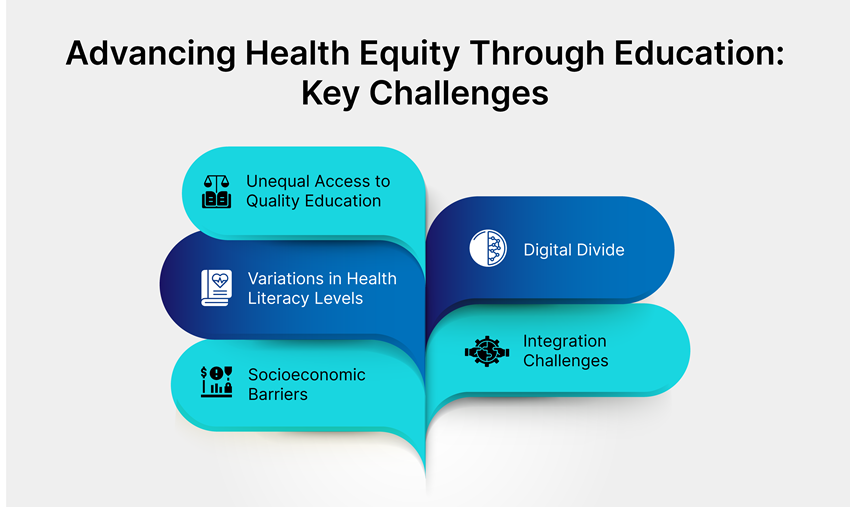
- Unequal Access to Quality Education
Disparities in access to education continue to limit opportunities for many individuals, particularly in underserved communities. Without equitable access, the benefits of education in improving health outcomes remain unevenly distributed.
- Variations in Health Literacy Levels
Differences in educational quality and resources can lead to varying levels of health literacy. This affects individuals’ ability to understand and apply health information effectively.
- Socioeconomic Barriers
Financial constraints and social inequalities can restrict access to both education and healthcare, reinforcing existing disparities.
- Digital Divide
While technology offers new opportunities, unequal access to digital resources can limit its effectiveness in reaching all populations.
- Integration Challenges
Incorporating health education into existing curricula requires careful planning and coordination. Ensuring that health topics are effectively integrated without overburdening educational systems is a key consideration.
Addressing these challenges is essential for ensuring that education can fully contribute to advancing health equity.
The Path Forward: Strengthening the Education–Health Connection
Moving forward, a more integrated approach is needed to strengthen the connection between education and health. This involves aligning policies, resources, and initiatives to ensure that education systems effectively support health equity goals. In line with the broader vision of achieving health for all, there is a growing need to ensure that education systems are inclusive, accessible, and responsive to the diverse needs of populations.
Collaboration between education and healthcare sectors is particularly important in achieving this alignment. By working together, these sectors can develop strategies that address both educational and health-related challenges in a coordinated manner. This collective approach reflects the importance of shared responsibility, echoing the global emphasis on working together to improve health outcomes through informed and science-based approaches.
Investing in education as a driver of health equity requires a long-term perspective. It involves not only expanding access but also improving the quality and relevance of education to ensure that it meets the needs of diverse populations. Strengthening scientific understanding and promoting evidence-based learning within education systems can further support informed decision-making, reinforcing efforts toward more equitable and sustainable health outcomes for all.
Conclusion
Advancing health equity requires a comprehensive approach that addresses the underlying factors influencing health outcomes, with education emerging as a sustainable solution that supports expanded access, greater awareness, and meaningful opportunities for healthier lives. By improving access to education, strengthening health literacy, and addressing key social determinants, it becomes possible to reduce disparities and promote more equitable outcomes, while also contributing to the development of healthier and more resilient communities. As the relationship between education and health continues to evolve, integrating these domains remains essential to building a future where everyone has the opportunity to achieve optimal health, regardless of their background or circumstances.
As global discussions on health equity continue to progress, initiatives such as World Health Day 2026 highlight the growing emphasis on collective action and a stronger reliance on scientific approaches to drive meaningful improvements in public health. The emphasis on science-driven approaches aligns closely with the role of education in building health literacy, enabling informed decision-making, and reducing disparities. By strengthening educational access and promoting knowledge grounded in reliable information, societies can move closer to achieving equitable health outcomes for all. This shared commitment highlights that advancing health equity is not an isolated effort, but a coordinated responsibility that brings together education, awareness, and scientific understanding to create lasting impact.
Frequently Asked Questions
Why is access to education important for improving health outcomes?
Access to education equips individuals with knowledge and skills that help them understand health risks, seek timely care, and adopt preventive practices, reducing disparities in health outcomes.
What is the role of health literacy in achieving health equity?
Health literacy enables individuals to access, understand, and use health information effectively, which is essential for managing health conditions and making informed healthcare decisions.
How can educational institutions contribute to health equity?
Educational institutions can promote health equity by integrating health education into curricula, raising awareness, and serving as platforms for community engagement and outreach initiatives.
What are the main challenges in using education to promote health equity?
Key challenges include unequal access to quality education, variations in health literacy, socioeconomic barriers, and disparity in access to digital resources in underserved communities.
Why is early education important for long-term health outcomes?
Early education builds foundational knowledge and habits related to hygiene, nutrition, and well-being, which significantly influence health outcomes later in life.
Latest
Trends blogs
- Skills and the Future of Work: How Employer Expectations Are Changing
- The Changing Role of Technology in Education: From Digital Classrooms to AI
- Preparing Universities for the AI Era: A Guide for Institutional Leaders
- The Future of AI Education: How Universities Are Equipping Students for Success
Focus blogs