

Microlearning in Higher Education: Benefits, Challenges and Future Impact

Higher education is undergoing a profound transformation as digital technologies reshape how knowledge is delivered and consumed. Traditional lecture-centered models, once considered the gold standard, are increasingly challenged by learners who seek flexibility, relevance, and efficiency. Among the emerging approaches, microlearning has gained remarkable attention for its ability to present information in short, focused segments that align with contemporary attention patterns and busy schedules. Instead of lengthy classroom sessions or dense textbooks, learners engage with concise modules designed to achieve specific outcomes within minutes. This shift is not merely a trend but a response to structural changes in society, employment, and technology. As universities and colleges confront declining attention spans, rising costs, and the need for lifelong learning, microlearning offers a pathway toward a more accessible and responsive educational ecosystem.
The Concept and Evolution of Microlearning
Microlearning refers to an instructional strategy that breaks complex subjects into small, manageable units delivered through digital or blended formats. Each unit typically targets a single concept or skill, allowing learners to focus intensely without cognitive overload. Although short learning segments have existed for decades in the form of study guides or flashcards, modern microlearning is deeply intertwined with mobile devices, interactive media, and on-demand platforms. The rise of smartphones and high-speed internet has made it possible for learners to access educational content anytime and anywhere, turning idle moments into opportunities for progress.
The approach reflects insights from cognitive science, particularly the understanding that the human brain processes information more effectively when it is presented in limited chunks. By spacing learning episodes and encouraging repetition, microlearning supports retention and application. A widely cited cognitive psychology study found that spaced learning significantly improves long-term memory compared to massed instruction, highlighting why brief, repeated exposure can outperform marathon study sessions. Microlearning also aligns with constructivist theories that emphasize active engagement rather than passive listening. Interactive quizzes, simulations, and short videos transform learners from recipients of information into participants in the learning process.
Key Drivers Accelerating Microlearning Adoption in Higher Education
Several forces are accelerating the adoption of microlearning within universities and colleges. One major factor is the changing profile of students. Many learners now balance academic pursuits with employment, internships, or family responsibilities, making rigid schedules less practical. Microlearning modules can be completed between other commitments, reducing barriers to participation and enabling continuous progress.
Another driver is the demand for skills that evolve rapidly in response to technological innovation. Traditional degree programs, often designed years in advance, struggle to keep pace with emerging fields. Microlearning allows institutions to update content quickly, introducing new modules without overhauling entire programs. This agility is particularly valuable in disciplines related to digital technologies, business practices, and healthcare, where current knowledge is essential.
Economic considerations also play a role. Developing full courses requires significant resources, while microlearning units can be produced more efficiently and reused across programs. This modular approach supports scalable education models that reach larger audiences, including working professionals seeking upskilling opportunities. According to a 2025 workplace learning report, 58% of employees prefer self-paced, short learning experiences over traditional training formats because of time constraints. Such preferences inevitably influence higher education as institutions compete with alternative learning providers.
Academic Benefits of Microlearning for Learners
Microlearning offers several benefits that extend beyond convenience.
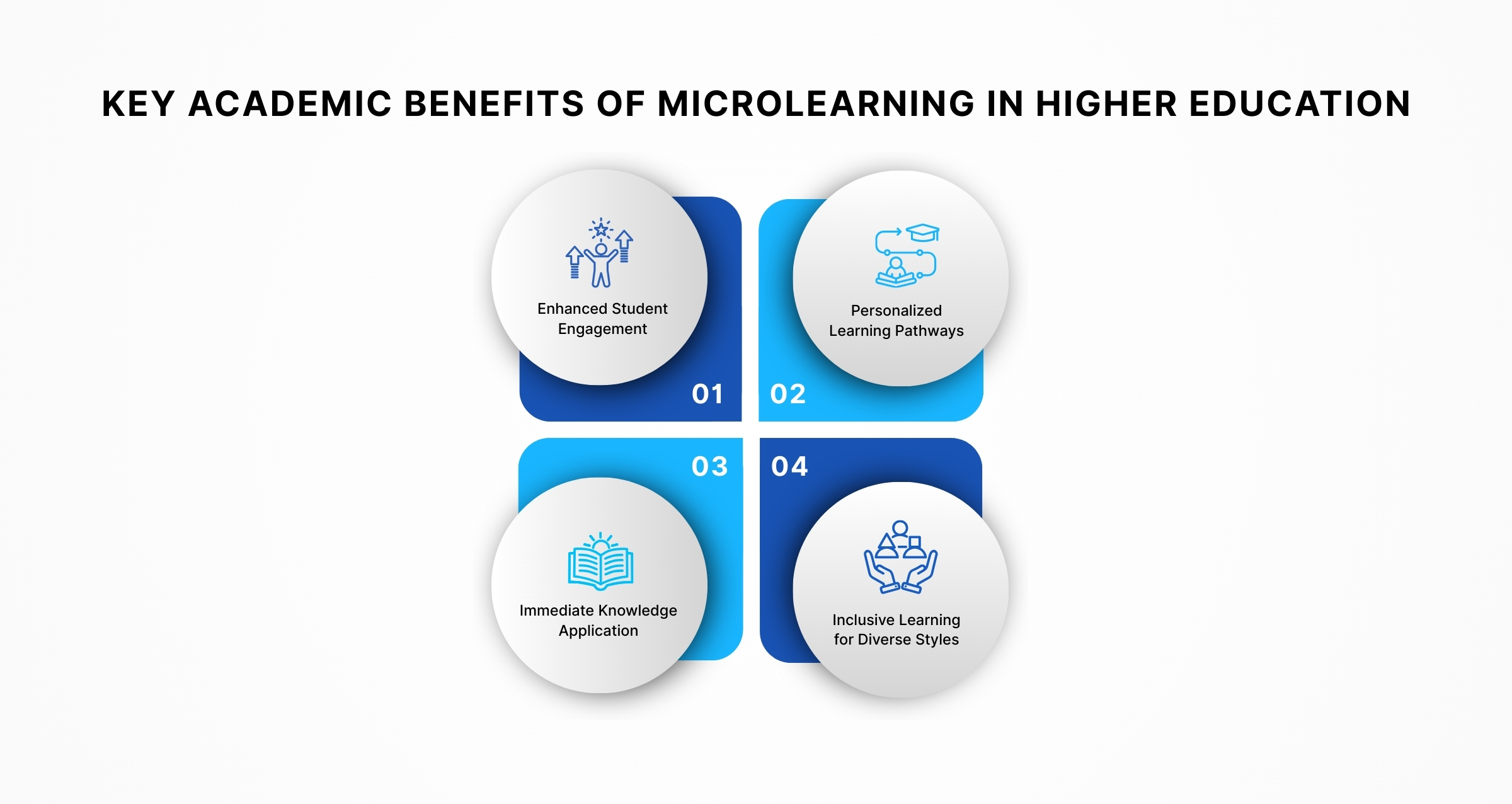
- 1. Enhanced Student Engagement
Microlearning enhances engagement by matching the media consumption habits of modern learners, who are accustomed to short videos and quick interactions on digital platforms. When educational content mirrors these patterns, students are more likely to remain attentive and motivated.
- 2. Personalized Learning Pathways
The approach in microlearning supports personalized learning pathways. Learners can select modules relevant to their needs, revisiting challenging topics or skipping material they have already mastered. This autonomy encourages ownership of the learning journey and reduces frustration associated with one-size-fits-all instruction. Adaptive systems can analyze performance data to recommend subsequent modules, creating a dynamic progression tailored to individual progress without explicitly redesigning the entire curriculum for each student.
- 3. Immediate Knowledge Application
Microlearning promotes immediate application. Because modules focus on specific skills or concepts, learners can quickly transfer knowledge to real-world tasks, reinforcing understanding through practice. In professional programs, short simulations or case studies enable students to experiment with decision-making in realistic scenarios. This connection between theory and application strengthens competence and confidence.
- 4. Inclusive Learning for Diverse Styles
Microlearning supports inclusivity by accommodating diverse learning styles. Visual learners benefit from infographics and videos, auditory learners from podcasts, and kinesthetic learners from interactive activities. The variety of formats ensures that no single mode dominates the educational experience.
Major Challenges and Criticisms of Microlearning
Despite its promise, microlearning is not without limitations.
- Risk of Oversimplification and Fragmentation
Critics argue that breaking subjects into small pieces may oversimplify complex ideas or fragment knowledge, making it difficult for learners to grasp broader contexts. Deep understanding often requires sustained reflection, discussion, and synthesis, which cannot always occur within brief sessions. Therefore, microlearning should complement rather than replace comprehensive instruction.
- Assessment and Evaluation Challenges
Another concern involves assessment. Traditional examinations may not accurately measure learning achieved through modular experiences. Institutions must design new evaluation methods that capture incremental progress and cumulative competence. Portfolio-based assessment, continuous feedback, and competency demonstrations are potential alternatives, but implementing them requires significant institutional change.
- Faculty Adaptation and Training Needs
Faculty adaptation also presents challenges. Educators trained in conventional teaching methods may need professional development to design effective microlearning content. Creating high-quality modules demands expertise in instructional design, multimedia production, and data analytics. Without adequate support, the burden on instructors could hinder adoption.
- Technological and Accessibility Barriers
Technological infrastructure is equally critical. Reliable platforms, data security, and accessibility features must be in place to ensure equitable participation. In regions with limited connectivity, reliance on digital delivery could exacerbate existing inequalities. Addressing these concerns is essential for the approach to achieve its transformative potential.
Integration with Emerging Technologies
Microlearning’s future is closely linked to advances in artificial intelligence, augmented reality, and learning analytics. Intelligent systems can analyze user behavior to recommend optimal learning sequences, predict difficulties, and provide instant feedback. This level of responsiveness creates a highly adaptive environment that evolves with each learner’s progress.
Augmented and virtual reality technologies enable immersive micro-experiences, allowing students to practice skills in simulated settings. For example, medical trainees can rehearse procedures in short virtual sessions, while engineering students can explore complex machinery through interactive models. These experiences bridge the gap between theoretical knowledge and practical application without requiring physical resources.
Learning analytics further enhance effectiveness by providing insights into engagement patterns and outcomes. Institutions can identify which modules generate the highest completion rates, where learners struggle, and how different demographics interact with content. Such data-driven decision-making supports continuous improvement and accountability.
Microlearning and Continuous Education
The significance of microlearning extends beyond degree programs. As career paths become less linear and technological disruption accelerates, individuals must update their skills repeatedly throughout their lives. Microlearning provides a flexible framework for continuous education, enabling professionals to acquire new competencies without pausing their careers.
Universities are increasingly exploring subscription-based models that grant access to libraries of short modules, allowing alumni and external learners to engage with content on demand. Such initiatives redefine the relationship between institutions and learners, shifting from one-time enrollment to ongoing partnership. Education becomes a lifelong service rather than a finite phase.
Moreover, microlearning supports interdisciplinary exploration. Learners can sample modules from different fields, discovering connections and expanding their perspectives without committing to full programs. This flexibility encourages intellectual curiosity and adaptability, qualities essential in an unpredictable future.
Reimagining Higher Education for the Microlearning Era
For microlearning to realize its revolutionary potential, higher education must rethink fundamental assumptions about curriculum design, accreditation, and credentialing. Modular learning raises questions about how knowledge is validated and recognized. Digital badges, micro-credentials, and competency-based certificates are emerging as alternatives to traditional degrees, offering granular recognition of skills.
Collaboration between institutions, industry, and technology providers will likely shape the next phase of development. By aligning microlearning content with real-world demands, universities can enhance graduate employability and relevance. Policy frameworks must also evolve to ensure quality assurance and equitable access.
Ultimately, the success of microlearning depends on maintaining a balance between efficiency and depth. Education is not merely the transmission of information but the cultivation of critical thinking, ethical awareness, and creativity. Microlearning can support these goals when integrated thoughtfully within a broader pedagogical strategy that includes discussion, mentorship, and experiential learning.
Reimagining AI and Machine Learning Education in India & Southeast Asia
Shaping the future of education through innovation, skills, and responsible AI adoption
Download the whitepaperConclusion
Microlearning represents a powerful response to the challenges facing higher education in the twenty-first century. By delivering concise, focused learning experiences, it addresses the needs of diverse learners navigating complex lives and rapidly changing professional landscapes. Its alignment with cognitive science, digital technology, and lifelong learning makes it a compelling component of the educational future. However, its implementation requires careful consideration to avoid fragmentation and ensure meaningful understanding.
When combined with robust assessment, supportive infrastructure, and complementary teaching methods, microlearning can transform universities into agile, inclusive, and responsive institutions. The revolution is not defined solely by shorter lessons but by a reimagined vision of education that prioritizes accessibility, adaptability, and continuous growth. As higher education embraces this approach, it moves closer to a model that empowers learners to engage with knowledge whenever and wherever curiosity arises, preparing them for a world where learning never truly ends.
Frequently Asked Questions
Q. How can universities maintain academic depth while adopting microlearning?
A. Universities can preserve academic rigor by integrating microlearning within broader curricula rather than using it in isolation. Short modules can introduce or reinforce key concepts, while seminars, projects, and research-based assignments provide opportunities for deeper reflection, critical analysis, and synthesis.
Q. Are micro-credentials and digital badges recognized by employers?
A. Recognition is steadily increasing, especially in skills-driven industries. Employers value clearly demonstrated competencies, and stackable credentials provide transparent evidence of specific abilities. However, their impact depends on quality standards, institutional credibility, and alignment with industry needs.
Q. How does microlearning support working professionals and adult learners?
A. Microlearning enables professionals to upskill without interrupting their careers. Short, on-demand modules fit into busy schedules and allow learners to acquire targeted competencies relevant to evolving job roles. This flexibility makes continuous education more accessible and sustainable.
Q. What role does technology play in the success of microlearning?
A. Technology is central to microlearning’s effectiveness. Artificial intelligence, learning analytics, and immersive tools help personalize content, track progress, and provide immediate feedback. Reliable digital platforms and strong data security systems are essential to ensure accessibility and quality.
Q. How might microlearning change the structure of traditional degree programs?
A. Microlearning could lead to more flexible degree structures built around modular coursework and stackable credentials. Instead of fixed, multi-year pathways, students may progress through personalized learning sequences, accumulating recognized competencies over time. This shift may allow learners to pause and resume education as needed while keeping their qualifications relevant to changing career demands.
Latest
Trends blogs
- Preparing Universities for the AI Era: A Guide for Institutional Leaders
- The Future of AI Education: How Universities Are Equipping Students for Success
- Building AI Literacy and Workforce Skills in Higher Education
- Intelligent Learning Systems: The Rise of Agentic AI in Higher Education
Focus blogs