

The Future of AI Education: How Universities Are Equipping Students for Success
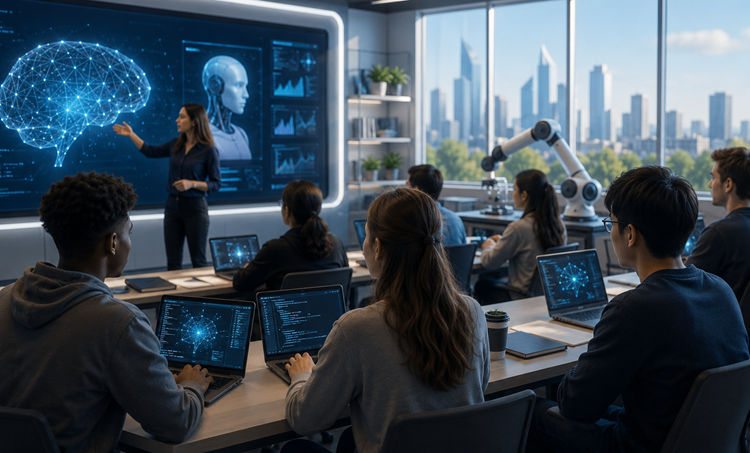
Artificial intelligence is moving beyond experimentation and becoming a major catalyst transforming how people work, communicate, solve problems, and make decisions. As AI technologies become increasingly integrated into industries ranging from healthcare and finance to manufacturing and education, universities are facing growing pressure to prepare students for an economy where AI literacy is becoming as important as digital literacy. The challenge extends beyond teaching technical skills. Higher education institutions must also help students understand how to work alongside intelligent systems, evaluate their outputs critically, and navigate the ethical implications of AI-driven decision-making.
According to the World Economic Forum’s Future of Jobs Report 2025, 86% of employers expect AI and information-processing technologies to transform their businesses by 2030, highlighting the growing importance of AI-related skills across industries. This shift is prompting universities to rethink curricula, teaching methods, and student support systems to ensure graduates remain competitive in an increasingly AI-driven workforce.
Why AI Education Has Become a Strategic Priority
The rapid evolution of AI technologies has created both opportunities and challenges for higher education. Traditional degree programs often struggle to keep pace with technological change, particularly when emerging tools and applications evolve faster than academic curricula can be updated.
Universities are increasingly recognizing that AI education should not be limited to computer science or engineering programs. AI now influences virtually every discipline, including business, healthcare, law, social sciences, media, and the arts. As a result, institutions are expanding AI-related learning opportunities across multiple fields of study.
This broader approach reflects a changing understanding of workforce readiness. Employers are seeking graduates who not only possess technical expertise but also understand how AI can be applied within specific professional contexts. The ability to combine domain knowledge with AI literacy is becoming an increasingly valuable skill.
Integrating AI Across the Curriculum
One of the most significant changes occurring in higher education is the integration of AI concepts into diverse academic disciplines. Rather than treating AI as a specialized subject, universities are embedding AI-related knowledge into existing programs.
For example, students studying healthcare may learn how AI supports diagnostics and patient care. Business students may explore predictive analytics and automated decision-making. Communication and media students may examine AI-generated content and its impact on information ecosystems.
This interdisciplinary approach helps students understand both the opportunities and limitations of AI within their chosen professions. It also encourages critical thinking about the broader societal implications of emerging technologies.
By integrating AI throughout the curriculum, universities can prepare students for workplaces where AI is likely to be a routine part of everyday operations.
Building AI Literacy Beyond Technical Skills
Preparing students for an AI-driven future requires more than teaching programming or machine learning concepts. AI literacy increasingly involves understanding how intelligent systems function, where they can be applied, and how their outputs should be interpreted.
Key areas of AI literacy include:
- Understanding the capabilities and limitations of AI systems
- Evaluating AI-generated information critically
- Recognizing bias and ethical risks in AI applications
- Using AI tools responsibly and effectively
- Understanding data privacy and security considerations
These competencies are becoming important for students regardless of their academic discipline. As AI tools become more accessible, the ability to use them thoughtfully and responsibly is emerging as a foundational workplace skill.
The Rise of Experiential and Project-Based Learning
Universities are increasingly adopting practical learning approaches to help students develop practical AI competencies. Traditional lectures alone are often insufficient for preparing students to work with rapidly evolving technologies.
Project-based learning allows students to apply AI tools to real-world problems, experiment with emerging technologies, and develop practical problem-solving skills. These experiences often mirror workplace environments where AI is used to support decision-making, automate processes, and generate insights.
Experiential learning opportunities may include:
- Industry-focused AI projects
- Collaborative interdisciplinary assignments
- AI innovation challenges and competitions
- Research initiatives involving AI applications
- Internship and work-integrated learning experiences
These approaches help bridge the gap between theoretical knowledge and practical application, ensuring students graduate with skills that are directly relevant to the workforce.
Preparing Students for an Evolving Job Market
The future of work is closely connected to the future of AI. Automation and intelligent systems are reshaping job roles across industries, creating demand for new skills while reducing reliance on some routine tasks.
According to the World Economic Forum’s Future of Jobs Report 2025, approximately 39% of workers’ current skill sets are expected to change by 2030 due to technological advancements and evolving labor market needs.
In response, universities are increasingly emphasizing adaptable skills that complement AI technologies rather than compete with them. These include creativity, critical thinking, communication, leadership, emotional intelligence, and complex problem-solving.
While AI can automate certain processes, many human capabilities remain difficult to replicate. Universities are therefore focusing on developing skills that enable graduates to collaborate effectively with intelligent systems while contributing uniquely human perspectives.
Ethical and Responsible AI Education
As AI becomes more powerful and widespread, ethical considerations are becoming a central component of higher education.
Students must understand not only how AI systems work but also the broader consequences of their deployment. Issues such as algorithmic bias, transparency, accountability, misinformation, privacy, and fairness are increasingly relevant across professional fields.
Universities are responding by incorporating discussions of responsible AI into coursework and research activities. This includes examining real-world case studies, exploring regulatory challenges, and encouraging students to consider the social impact of technological innovation.
Ethics education is particularly important because future graduates may play key roles in designing, implementing, regulating, or managing AI systems. Their decisions will influence how these technologies affect individuals, organizations, and society.
Supporting Faculty in the Age of AI
The success of AI education depends not only on students but also on educators. Faculty members must adapt their teaching methods, assessment strategies, and course content to reflect emerging technologies.
Many universities are investing in professional development programs that help educators understand AI tools and incorporate them effectively into teaching practices. These initiatives focus on both technical understanding and pedagogical adaptation.
AI is also changing how learning is assessed. Traditional assignments may need to be redesigned to account for the availability of generative AI tools. Educators are increasingly emphasizing critical analysis, problem-solving, collaboration, and authentic assessment methods that demonstrate genuine understanding.
By supporting faculty development, institutions can ensure that AI integration enhances educational quality rather than disrupting it.
Challenges in Integrating AI into Higher Education
Despite significant progress, several challenges remain:
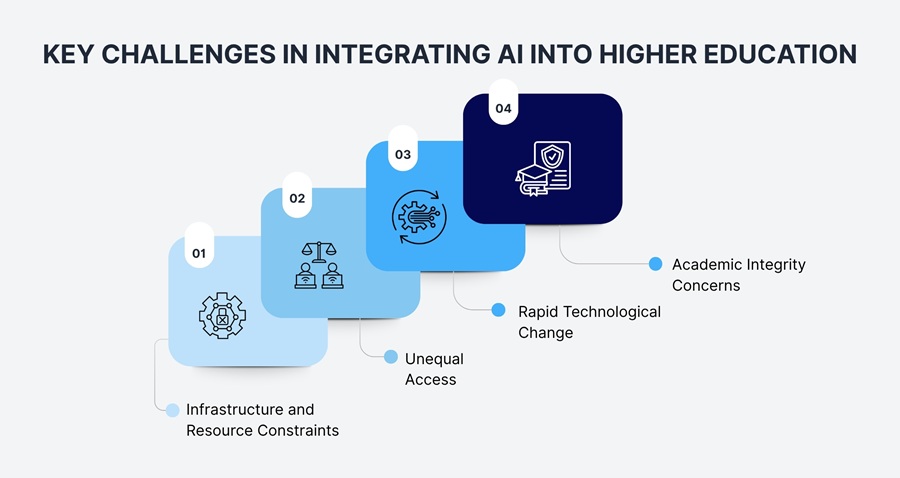
- Infrastructure and Resource Constraints: Implementing AI-related programs often requires substantial investment in technology, training, and digital infrastructure.
- Unequal Access: Not all students have equal access to AI tools, devices, or reliable internet connectivity, creating potential disparities in learning opportunities.
- Rapid Technological Change: The pace of AI innovation makes it difficult for curricula and educational policies to remain current.
- Academic Integrity Concerns: The widespread availability of generative AI tools is raising new questions about originality, assessment, and responsible use.
Addressing these challenges will require continuous adaptation, collaboration, and strategic planning across the higher education sector.
Upcoming Directions in AI Learning
The future of AI education is likely to be characterized by greater personalization, interdisciplinary learning, and continuous skill development. Universities will increasingly move beyond teaching AI as a specialized subject and instead integrate it throughout the student learning experience.
Future graduates will be expected to understand how to work effectively with intelligent technologies while maintaining strong human-centered skills. This combination of technical understanding and adaptability will be essential for success in evolving workplaces.
As AI continues to influence every aspect of society, universities will play a critical role in ensuring that students are equipped to use these technologies effectively while also contributing to their responsible and ethical development.
Conclusion
The growing influence of artificial intelligence is reshaping higher education and redefining the skills students need to succeed. Universities are responding by integrating AI across disciplines, expanding experiential learning opportunities, strengthening AI literacy, and placing greater emphasis on ethical and responsible technology use.
Equipping students for AI-influenced workplaces more than teaching technical skills alone. It involves developing critical thinking, adaptability, creativity, and ethical awareness alongside technological competence. Ultimately, the goal is to equip learners to work alongside artificial intelligence effectively, responsibly, and creatively, enabling them to thrive in a future where human expertise and intelligent technologies increasingly work together.
Latest
Trends blogs
- Preparing Universities for the AI Era: A Guide for Institutional Leaders
- The Future of AI Education: How Universities Are Equipping Students for Success
- Building AI Literacy and Workforce Skills in Higher Education
- Intelligent Learning Systems: The Rise of Agentic AI in Higher Education
Focus blogs