


Education Technology in 2026: Trends Driving the Next Wave of Learning
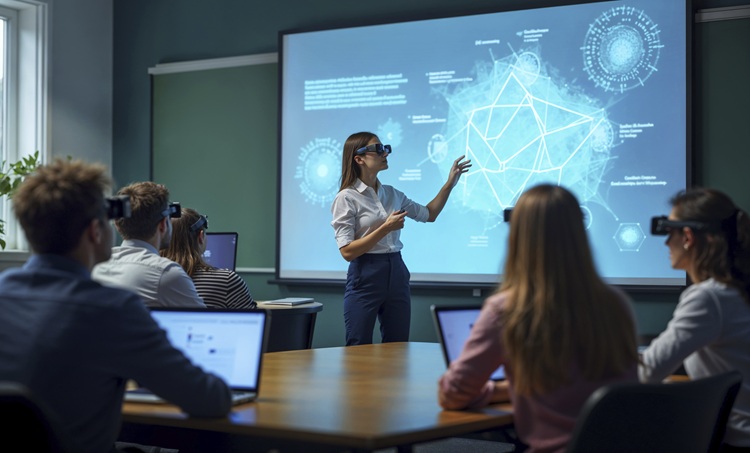
Education is entering a phase of rapid reinvention as technology reshapes how people learn and share knowledge. As digital-native generations enter classrooms, and global expectations emphasize flexibility, relevance, and adaptability, education technology is evolving to meet these needs. In 2026, a fresh wave of innovations is set to reshape how people learn, what they learn, and how learning is measured, from immersive experiences to AI-driven personalization, from micro-learning tokens to data-informed teaching. This article explores the major trends powering this transformation and what they signal for the future of education.
Why 2026 Matters: A Turning Point for EdTech
Recent years have witnessed rapid growth in educational technology investment and adoption. Accelerated by global disruptions and the acceleration of digital infrastructure, learners, educators, and institutions are now embracing new models of teaching and learning. What was experimental in 2020–2022 has become mainstream or is on the cusp of mainstream adoption. As technologies mature and scale, 2026 stands out as a pivotal year for EdTech to shift from novelty to foundational infrastructure, blending convenience, quality, access, and innovation.
What’s Defining the Future of Education Technology in 2026
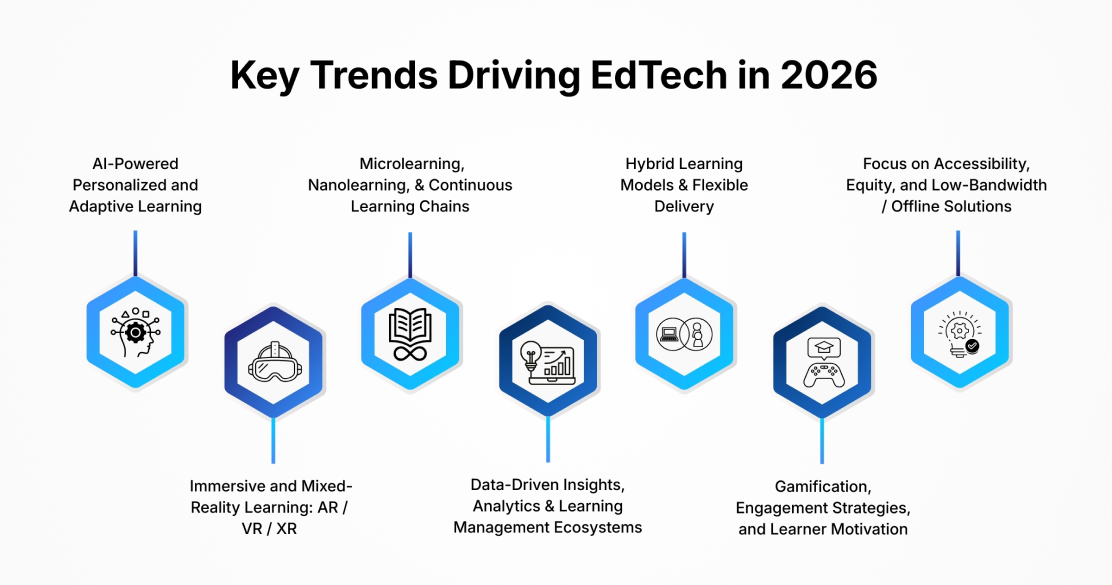
Learning environments are moving toward more adaptive, connected, and intelligence-driven systems. The trends defining 2026 show how technology is reshaping both instruction and student experience.
-
AI-Powered Personalized and Adaptive Learning
Artificial intelligence continues to lead the transformation. Learning platforms will increasingly use machine-learning algorithms and large language models to adapt curriculum content, pace, and difficulty based on each learner’s performance and preferences. AI-powered tutors will provide on-demand academic support, answer questions in real time, and guide learners through complex topics whenever they need help. These systems are expected to reduce administrative burdens on educators, such as grading or basic feedback, allowing teachers to focus on mentoring, higher-order discussion, and human-centric interaction.
AI-driven assessment and grading systems will also become more common. These platforms will be able to evaluate not only objective items but also essays, project-based work, and creative assignments. Automated grading can significantly shorten feedback cycles, reduce human bias, and enable more frequent formative assessment, providing learners with timely guidance on areas to improve.
-
Immersive and Mixed-Reality Learning: AR / VR / XR
By the upcoming year, immersive technologies, including augmented reality (AR), virtual reality (VR), and mixed reality (XR), are expected to move from pilot projects to core elements in many educational settings. Use cases range widely, from virtual lab experiments for science students, simulated field trips for humanities and geography classes to virtual trade-skill workshops and interactive 3D visualizations of historical events or biological processes.
Mixed-reality enables realistic, hands-on experiences where students can practise procedures, manipulate virtual objects, and receive immediate feedback, without risk, cost, or the restrictions of physical resources. Such tools especially benefit practical disciplines and skills-based learning, making experiential learning scalable and more equitable.
-
Microlearning, Nanolearning, & Continuous Learning Chains
Traditional semester courses are increasingly complemented or replaced by modular, shorter learning units. Microlearning and nanolearning modules deliver tightly focused lessons, often under 10–20 minutes, teaching specific skills or concepts. Educational models will increasingly support continuous learning chains, where learners accumulate short modules over time, gradually building comprehensive competencies without committing to long-term, rigid programs in the near future.
This approach is particularly beneficial for working professionals, lifelong learners, or individuals seeking upskilling or reskilling without interrupting their careers. It also aligns with changing workforce demands where adaptability and ongoing learning are essential.
-
Data-Driven Insights, Analytics & Learning Management Ecosystems
With widespread adoption of digital learning platforms, 2026 will see enhanced use of learning analytics and data-driven decision tools. Learning Management Systems (LMS) will increasingly incorporate dashboards that track student engagement, performance trends, time spent per unit, and mastery levels. Educators can use these insights to intervene early when learners struggle, personalize pacing, or recommend additional support.
Predictive analytics may help forecast dropout risks, identify knowledge gaps, and guide curriculum adjustments. Institutions may also employ data to evaluate program effectiveness, compare pedagogical strategies, and support accountability in education outcomes. This shift brings education closer to evidence-based practice and continuous improvement.
-
Hybrid Learning Models & Flexible Delivery
Hybrid and flexible learning models, combining online, in-person, and asynchronous elements, gained traction during the pandemic and are here to stay. In the next phase of development, these models are expected to be widely adopted across all levels of education. Students might engage in online lectures, virtual labs, peer collaboration platforms, and in-person sessions for discussion, practical work, or social learning, offering both flexibility and depth.
Flexible delivery supports diverse learners like working adults, remote learners, or those needing flexible schedules, and helps expand access to quality education beyond traditional classroom constraints. Cloud-based learning management tools, scalable infrastructure, and improved internet connectivity make this possible at scale.
-
Gamification, Engagement Strategies, and Learner Motivation
Gamification, using game design elements like points, levels, badges, challenges, and instant feedback, is becoming more sophisticated. As the next phase unfolds, many curricula are projected to incorporate educational simulations and game-based learning activities across subjects and learning stages. These strategies help maintain learner motivation, encourage active participation, and support deeper engagement with material.
Gamified assessments, scenario-based tasks, and collaborative game-like projects can also promote soft skills development including problem-solving, decision-making and teamwork, alongside traditional content knowledge, making learning more holistic and aligned to real-world demands.
-
Focus on Accessibility, Equity, and Low-Bandwidth / Offline Solutions
While EdTech expands rapidly, equal access remains a challenge, especially in regions with limited internet connectivity or poor infrastructure. Over the coming period, some platforms are expected to prioritize offline-first design, lightweight apps, or low-bandwidth delivery to ensure inclusion.
Such efforts, combining adaptive learning, microlearning modules, and offline access, can reduce barriers for learners in underserved or rural communities, helping democratize education. This shift toward inclusive EdTech aligns with global calls for equity and universal access.
Enhancing Higher Education with Generative AI
Discover how universities can adopt generative AI responsibly, to advance academic integrity, student success, and institutional trust.
DOWNLOAD WHITEPAPERWhat May Hold the Key: Education 5.0 & Future-Ready Frameworks
Emerging scholarship describes a shift toward what could be called “Education 5.0”: a learner-centered paradigm where digital technologies, human-centric pedagogy, continuous skills development, and lifelong learning converge. This concept integrates AI, adaptive systems, VR/AR, data analytics, and modular learning to design education that adapts to individuals and societal needs simultaneously.
Education 5.0 envisions flexible learning pathways, competency-based progression, and emphasis on soft skills, creativity, and adaptability. The shift is from institution-centered credentialing to learner-centered competence-building. In this framework, education is not a one-time phase but a continuum that evolves with careers and life contexts, well-suited to a future where industries and demands change fast.
Also Read: Reimagining Learning for the Future: Education 5.0
Challenges and Considerations for the Upcoming Educational Year
While these trends offer promise, they also bring new challenges that educators, policymakers, and stakeholders must address:
- Digital Divide & Equity Issues: Unless infrastructure and connectivity improve globally, many learners risk being left behind. Equal access to devices, stable internet, and supportive environments remains critical for EdTech equity.
- Data Privacy & Ethical Use of AI: As AI-driven platforms collect increasing amounts of learner data, issues related to privacy, transparency, bias, and fairness become more acute. Ensuring responsible design and compliance with ethical standards is essential.
- Teacher Readiness & Professional Development: Adopting advanced tools and pedagogies requires training, ongoing support, and a shift in mindset. Educators must be comfortable using new technologies while maintaining pedagogical quality and human connection.
- Sustainability of Investment: In many regions, financial strain, maintenance of infrastructure, licensing costs, and digital resource updates may pose obstacles to long-term EdTech adoption.
- Assessment Integrity and Academic Standards: While AI-based grading and adaptive testing are efficient, ensuring that assessments remain rigorous, fair, and meaningful requires careful design, validation, and oversight.
- Cultural & Contextual Relevance: EdTech solutions must adapt to local languages, learning contexts, cultural values, and community needs. One-size-fits-all global platforms may fail to address specific educational realities.
Implications for Educators, Institutions, Learners, and Policymakers
These trends have profound implications across stakeholders:
- For Educators: A shift toward facilitation, mentorship, and personalized guidance; augmented by AI and analytics, but still centered on human connection. Flexibility and lifelong professional learning become essential.
- For Institutions: Need to invest strategically in infrastructure, capacity building, and sustainable models that balance innovation with equity and access. Curriculum design must evolve to integrate flexible, modular, and competency-based pathways.
- For Learners: Opportunities for personalized learning journeys, flexible pacing, and lifelong skill development. Learners can combine formal education with micro-credentials, continuous upskilling, and portfolio-based learning.
- For Policymakers: Role in setting standards, ensuring quality, protecting data privacy, investing in connectivity and infrastructure, and enabling inclusive regulation that supports innovation while safeguarding equity.
Conclusion
Education technology in 2026 stands at the cusp of a new paradigm, one where learning becomes personalized, flexible, immersive, and continuous. The convergence of artificial intelligence, immersive tools, microlearning, data analytics, and hybrid delivery is transforming education into a dynamic ecosystem capable of adapting to rapid social, economic, and technological change.
Yet the promise of EdTech will only be realized when adoption is inclusive, ethical, and supported by human-centered pedagogy and sound governance. As we move forward, stakeholders — educators, institutions, learners, and policymakers, must work together to harness technology responsibly, ensure equitable access, and build learning systems that empower individuals for a future of continuous growth.
2026 may mark the beginning of the next wave of learning, defined not merely by new tools, but by a holistic reimagining of what education can be.
Latest
Trends blogs
- Skills and the Future of Work: How Employer Expectations Are Changing
- The Changing Role of Technology in Education: From Digital Classrooms to AI
- Preparing Universities for the AI Era: A Guide for Institutional Leaders
- The Future of AI Education: How Universities Are Equipping Students for Success
Focus blogs