

From Managers to Leaders: How Executive Education Shapes the Future of Leadership

In a fast-changing global business environment, traditional leadership models are no longer sufficient. Organizations are facing pressures from technological disruption, shifting markets, global competition, and an ever-greater demand for agility and creativity. In this context, executive education has emerged as a powerful lever for growth and innovation.
The Changing Landscape of Leadership and Growth
Leadership in the past was often about maintaining control, optimising current operations, and driving incremental improvements. Today’s successful leader must recognise complex interdependencies, anticipate disruptive trends, and mobilise teams to create new value. Innovation is no longer optional, it is fundamental to organizational survival and growth. Various analyses show that growth in many sectors now comes less from simply repeating past successes and more from launching new business models, entering fresh markets, leveraging digital technologies, or streamlining processes in radically new ways.
Moreover, the so-called leadership gap, that space between what organizations need from their leaders and what behaviours or skills leaders currently bring, has become more evident. Challenges such as rapid digital disruption, the rise of AI, remote and hybrid working, and increasing demands for sustainability all contribute to this gap. Given this backdrop, executive education programs serve as a strategic mechanism to reinvent leadership, shifting focus from just managing today to designing tomorrow.
Understanding Executive Education and Its Role in Driving Organizational Transformation
Executive education refers to advanced learning programs aimed at senior leaders and high-potential managers designed to elevate strategic thinking, leadership capability, and business impact. These programs combine theory, practice, peer learning, and immersion to help participants unlock new perspectives and translate them into action.
A highlight of executive education is the move toward flexible, blended, lifelong learning formats, combining online modules, in-person sessions, and peer-group engagements. This shift responds to the shrinking half-life of business skills, increasing demands for continuous development, and the need for accessible leadership pathways.
By investing in executive education, organizations not only upgrade their leadership bench but also signal a commitment to growth and innovation. The programs become a mechanism to accelerate transformation, by equipping leaders with tools, networks, and mind-sets to deliver.
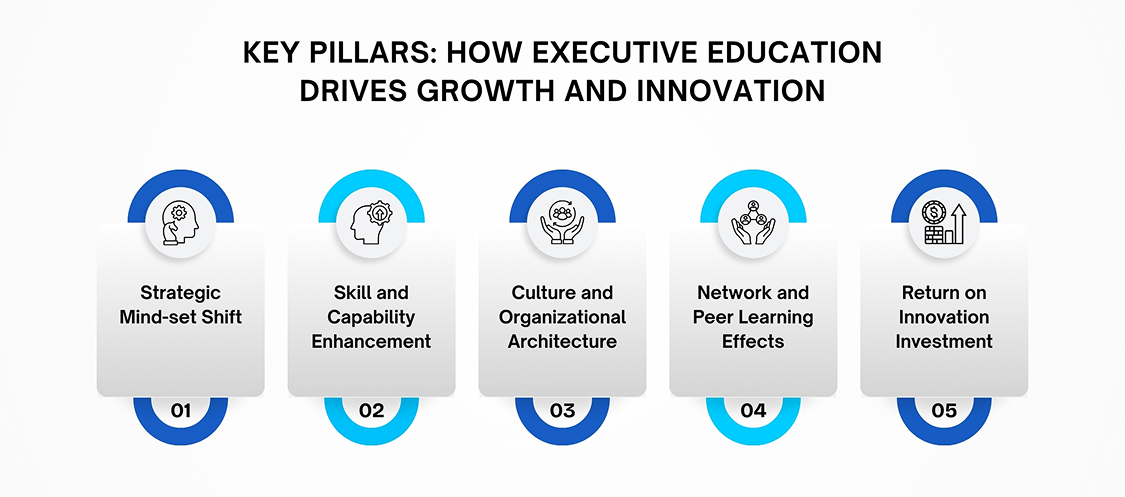
Key Pillars: How Executive Education Drives Growth and Innovation
Here are some of the core mechanisms through which executive education fuels growth and innovation:
-
Strategic Mind-set Shift
Rather than only managing operational excellence, executive education encourages leaders to think of growth as both extension of existing business and creation of new business. This includes reassessing value propositions, exploring adjacent markets, and developing disruptive models. Programs in innovation emphasise balancing incremental and discontinuous innovation. In doing so, leaders begin to adopt a growth-oriented leadership orientation rather than a merely efficiency-oriented one. -
Skill and Capability Enhancement
Leadership today demands not only vision but also the ability to lead through ambiguity, integrate digital technologies, mobilise diverse teams, and embed creativity in routines. Executive education offers curricula covering digital strategy, innovation frameworks, value chain design, and leadership dynamics in complex settings. -
Culture and Organizational Architecture
Innovation is as much about culture as it is about ideas. Executive education often incorporates modules to design and sustain a culture conducive to experimentation, risk-taking, collaboration across boundaries, and agility. One program emphasises creating the behaviours and incentives that support innovation inside the organization. The leadership cohort then becomes a change agent, shaping not just strategy but the underlying architecture of how things are done. -
Network and Peer Learning Effects
These programs bring together diverse leaders from multiple industries and geographies, creating a rich peer network. Participants share experiences, challenge assumptions, and accelerate learning through interaction. The social capital built through executive education becomes a force multiplier for innovation by cross-pollination of ideas, exposure to different business models, and access to new perspectives. -
Return on Innovation Investment
From an organizational perspective, executive education supports innovation by translating learning into action by identifying growth opportunities, aligning resources, and executing new initiatives. Growth-oriented programs emphasise not only vision but deployment like how to commercialise innovation, how to resource opportunity, how to change the metrics that reward growth over maintenance. This alignment of leadership development with innovation processes helps ensure that investment in people translates into value creation.
Organizational Strategies to Drive Growth Through Executive Education
For organizations considering investment in executive education to drive growth and innovation, several practical factors merit attention.
- Alignment: The content of the program must align with the organization’s strategic priorities. If the organization is aiming for digital-enabled growth, then leadership programs should emphasise digital strategy, value-chain innovation and change leadership.
- Integration: Learning alone is not sufficient. Organizations must create mechanisms to translate education into action. This means linking program outcomes with organizational structures such as innovation units, digital transformation offices, or new venture teams.
- Measurement: It is useful to set clear metrics before the program, such as What leadership behaviours should change? What innovation outcomes are expected? This gives greater accountability and visibility for investment.
- Cohort Selection: Selecting participants carefully ensures the learning cohort can act as change agents. Participants should not only hold senior rank but also have the ability and mandate to influence the organization’s innovation agenda.
- Sustained Engagement: Executive education works best when it is part of a continuous journey rather than a one-off event. Organizations should consider follow-up support, alumni networks, peer cohorts, and internal communities of practice to maintain momentum.
- Culture Support: The effectiveness of leadership education will depend on the organizational context. If the culture is rigid, risk averse, or hierarchical, even well-trained leaders may struggle to apply their learning. Leadership education must be complemented by culture change initiatives, aligning incentives and processes with growth-oriented behaviours.
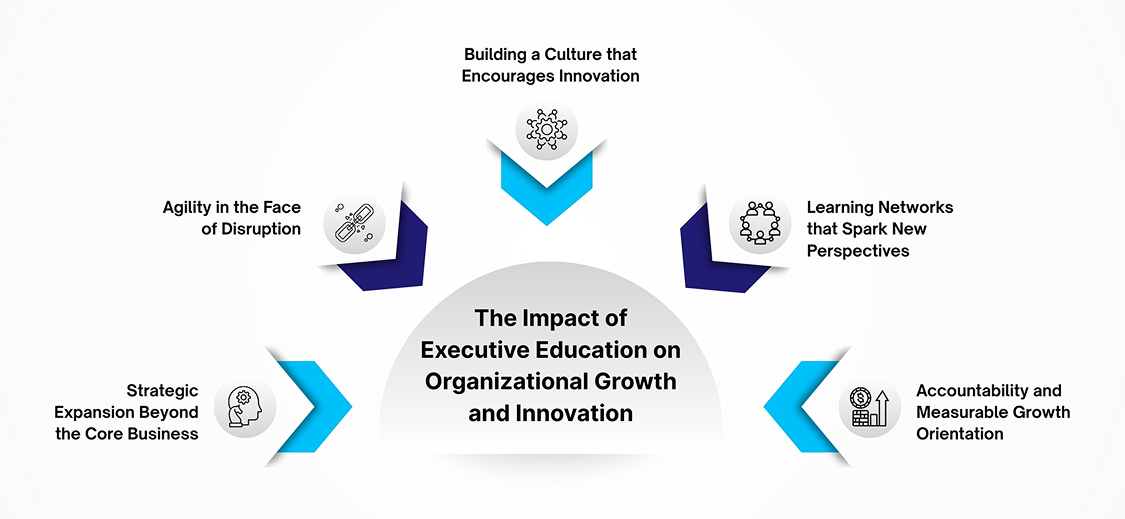
The Impact of Executive Education on Organizational Growth and Innovation
The following key areas illustrate how these programs translate leadership development into real organizational impact.
-
Strategic Expansion Beyond the Core Business
Executive education equips leaders with the ability to think beyond current markets and operational comfort zones. With renewed strategic orientation, leaders learn to identify emerging opportunities, create new business models, and expand into untapped markets. This shift from optimisation to exploration enables organizations to achieve growth that extends beyond their traditional boundaries. -
Agility in the Face of Disruption
Modern leadership requires the ability to navigate volatility and uncertainty. Through executive education, leaders develop skills to design agile organizations, make quick yet informed decisions, and adopt digital enablers that enhance responsiveness. This agility helps organizations innovate faster and capture value before competitors, turning disruption into an opportunity rather than a threat. -
Building a Culture that Encourages Innovation
A major outcome of executive education is the transformation of organizational culture. Leaders learn how to create environments where creativity is encouraged, experimentation is supported, and calculated risks are seen as learning opportunities. When leadership behaviours align with innovation-driven values, organizations can sustain a culture that continuously generates and scales new ideas. -
Learning Networks that Spark New Perspectives
Executive education programs bring together diverse professionals from various sectors, industries, and regions. This exposure enables leaders to exchange insights, challenge conventional thinking, and discover new approaches to problem-solving. -
Accountability and Measurable Growth Orientation
Leadership development becomes most effective when linked to clear performance metrics. Executive education encourages leaders to think in terms of measurable growth outcomes, such as resource allocation, commercialisation of ideas, scaling innovation, and enhancing value creation. This accountability ensures that learning is not abstract but directly connected to tangible business performance.
What’s Next for Executive Education and Leadership Innovation
Looking ahead, the scope and impact of executive education appear set to expand in several directions.
First, the application of advanced technologies, such as artificial intelligence-powered learning platforms, simulation-based leadership labs, immersive experiences, will enhance the relevance and scalability of programs. Trends already highlight integration of digital tools to accelerate learning outcomes.
Second, leadership education will increasingly emphasise not only growth and innovation but also sustainability, purpose, inclusive leadership and ethical dimensions of change. As organizations face societal expectations and regulatory pressures, leadership skills will evolve to include stakeholder ecosystems beyond shareholders.
Third, the line between leadership development and innovation capability may blur, leadership programs may become tightly integrated with innovation incubators, corporate venturing functions, and continuous learning ecosystems rather than standalone efforts. Executive education may move from classroom to action labs where innovation is prototyped and scaled in real time.
Fourth, globalisation and remote/hybrid business models will influence leadership education’s format and content. Leaders will need to manage distributed teams, virtual decision-making and cross-cultural innovation dynamics. Executive education programs will reflect that shift.
Conclusion
Leadership today must extend beyond operational efficiency to embrace growth mindsets, innovation fluency, cultural adaptability, and strategic renewal. Executive education serves as a vital pathway for organizations to close the gap between existing leadership capabilities and future demands. By equipping leaders with forward-thinking perspectives, advanced skills, diverse networks, and a strong growth orientation, these programs enable transformation that reaches beyond incremental improvement to drive fundamental change. Organizations that invest in this strategic lever are better positioned to achieve sustainable performance, generate new value, and maintain a competitive edge in an era defined by rapid and continuous change.
Latest
Trends blogs
- Skills and the Future of Work: How Employer Expectations Are Changing
- The Changing Role of Technology in Education: From Digital Classrooms to AI
- Preparing Universities for the AI Era: A Guide for Institutional Leaders
- The Future of AI Education: How Universities Are Equipping Students for Success
Focus blogs