

Skills and the Future of Work: How Employer Expectations Are Changing

A college degree has long been a signal of career readiness. It demonstrates subject knowledge and structured study. But employers are increasingly asking what a candidate can actually do.
The shift does not mean degrees have lost their value. In many professions, formal qualifications remain essential. What is changing is how hiring teams evaluate candidates alongside them. Practical skills, experience, problem-solving ability, digital fluency, and the capacity to learn are becoming more visible.
This shift is particularly important in 2026, as artificial intelligence continues to change tasks and job requirements. When tools automate parts of technical work, recruiters need people who can apply knowledge, evaluate outputs, communicate decisions, and adapt. Credentials may open a door, but practical abilities now have a greater influence on what happens next.
Why Skills Are Becoming a Stronger Hiring Signal
The changing value of skills is closely connected to the pace at which jobs themselves are evolving. A qualification reflects what a person has studied, but a skill demonstrates what that person is prepared to do. Companies therefore have greater reason to examine capabilities that can be applied to current business needs.
According to the World Economic Forum’s (WEF) Future of Jobs Report 2025, employers expect 39% of workers’ core skills to change by 2030, while analytical thinking remains the most sought-after core skill, with seven in ten employers considering it essential in 2025. The report’s workforce strategy findings further show that 81% of employers expect to continue using work experience in hiring through 2030, compared with 48% planning to use skills assessments and 43% expecting university degrees to remain a requirement.
This level of skill change makes adaptability more important than ever. Modern workplaces need people who can learn new tools, transfer knowledge to unfamiliar situations, and develop alongside emerging roles.
How Hiring Is Moving Beyond Degree Requirements
Greater emphasis on demonstrated skills does not necessarily mean recruiters are abandoning degrees. Instead, some organizations are reducing their reliance on degrees as the primary screening mechanism, particularly when a role can be performed effectively through demonstrated competencies and experience.
According to LinkedIn’s Future of Recruiting 2025, 26% of paid job posts on its platform did not require a degree in 2023, compared with 22% in 2020.
The change is also visible in how organizations assess candidates. Work experience, skills assessments, practical demonstrations, portfolios, and structured interviews can provide evidence that a resume alone cannot. This gives candidates more opportunities to demonstrate what they can do.
However, the degree remains important in many careers. Medicine, law, engineering, teaching, and other regulated or specialized professions may require specific academic qualifications, licenses, or professional credentials. A greater focus on skills in hiring should therefore be understood as an expansion of how employee talent is assessed, rather than a universal replacement for degrees.
What Employers Are Looking for in Modern Hiring
The skills companies value are becoming broader than technical proficiency. A strong candidate may need to combine specialized knowledge with qualities that support effective decision-making and collaboration.
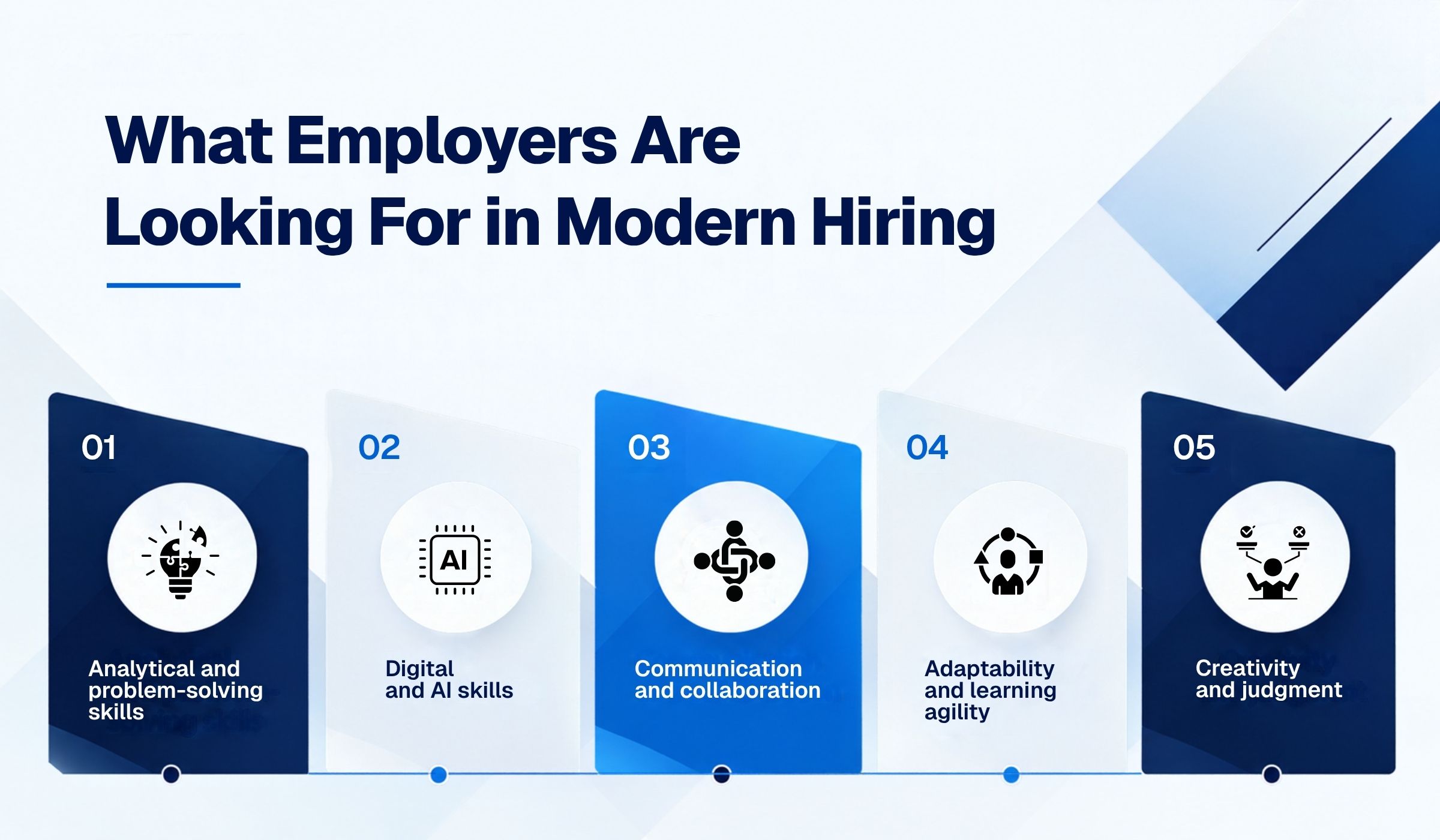
- Analytical and problem-solving skills: Contemporary workplaces need people who can interpret information, identify problems, evaluate alternatives, and make sound decisions.
- Digital and AI skills: Employees now need to work with digital systems, automation, data, and AI tools while understanding their limitations.
- Communication and collaboration: Technical ability has limited value if employees cannot explain ideas, work with colleagues, or communicate with customers and stakeholders.
- Adaptability and learning agility: As tools and processes change, employees must be capable of acquiring new skills rather than depending entirely on existing knowledge.
- Creativity and judgment: AI can generate options and information, but people still need to determine which ideas are useful, appropriate, and reliable.
These capabilities are interconnected. Technical expertise has greater value when employees can communicate findings, collaborate, and apply knowledge to real problems.
AI Is Changing What It Means to Be Skilled
Artificial intelligence is accelerating the movement toward capability-based evaluation by changing how knowledge translates into task performance. Some activities that previously demonstrated specialist expertise can now be partly automated. This does not make expertise irrelevant. Instead, it changes where human expertise creates value.
Consider a marketing graduate who can use AI to generate campaign ideas. Basic content generation may become largely automated, so the differentiating skills become audience analysis, strategic thinking, fact-checking, brand judgment, and the ability to decide which ideas are worth developing.
The same principle applies to coding, data analysis, design, customer service, and administrative work. Knowing how to operate a tool matters, but understanding the problem, checking the output, and improving the result can matter more.
This creates demand for professionals who combine domain knowledge with technology skills. The strongest preparation is therefore not simply learning a collection of AI tools. It is developing the judgment to decide when and how those tools should be used.
Demonstrating Competencies in this Hiring Era
A skills-first hiring environment changes how candidates should present themselves. Listing a skill on a resume is weaker evidence than showing how that skill was applied.
Candidates demonstrate their capability through:
- Projects that solve realistic problems
- Portfolios showing completed work
- Internships and apprenticeships
- Certifications linked to specific competencies
- Freelance or volunteer experience
- Practical assessments and simulations
- Clear examples of measurable results
Instead of simply listing “data analysis,” a candidate could describe a project in which they analyzed a dataset, identified a pattern, and used the findings to support a decision. Communication skills can similarly be demonstrated through presentations, client interactions, or team projects.
This approach gives stronger evidence in evaluation while helping candidates connect learning with outcomes.
The Growing Importance of Continuous Learning
This evolving approach to hiring also changes what happens after recruitment. Hiring someone for the skills they currently possess is only part of the equation when those skills may evolve quickly.
Insights from the WEF’s Future of Jobs Report 2025 show that 50% of workers have completed training as part of long-term learning strategies, up from 41% in its 2023 edition.
For employees, career development depends heavily on maintaining and expanding relevant expertise. Short courses, certifications, employer training, project experience, and self-directed learning can complement formal education.
For employers, the implication is equally important. Companies that recruit only for today’s skills may struggle as technologies and business requirements change. Hiring people with learning agility allows organizations to strengthen their workforce base over time rather than repeatedly searching for completely new talent.
Strengthening Career Readiness Through Skills-Based Education
A greater emphasis on skills in hiring also places pressure on universities and other educational institutions. Academic knowledge remains important, but students need more opportunities to apply that knowledge in realistic settings.
Project-based assignments, internships, simulations, industry collaborations, practical assessments, and portfolios can help students connect classroom learning with workplace expectations. Courses can also identify the competencies developed through each learning experience.
This does not require universities to choose between degrees and skills. A degree can provide the foundation, while applied experiences provide evidence of what students can do with that knowledge.
The goal is to produce graduates who can explain what they studied, apply it, solve problems, work with others, and continue learning.
The Future of Skills-Based Learning
The shift toward skills-focused hiring is likely to remain uneven. Some sectors will continue to depend heavily on degrees and professional credentials, while others may place greater emphasis on demonstrated practical evidence. Organizations will also need reliable methods for assessing skills.
The WEF’s figures mentioned earlier suggest that the future is unlikely to be a simple choice between degrees and skills. Organizations are more likely to combine qualifications with experience, assessments, portfolios, and demonstrated capabilities.
Read More - Innovating Higher Education: Transitioning to Skills-Based Learning
Conclusion
The workplace is placing greater emphasis on what people can apply, demonstrate, and build over time. This makes career readiness a combination of knowledge, practical ability, and the capacity to work effectively with modern technologies. AI literacy is becoming part of that equation, helping professionals use AI tools with accuracy, judgment, and purpose.
A strong career foundation therefore extends beyond what a person knows. Knowledge provides the depth to understand a problem, practical skills turn that knowledge into action, AI literacy enables effective use of new tools, and demonstrated capability provides evidence of real-world performance. Together, these qualities offer a more complete picture of what a professional brings to the workplace.
Latest
Trends blogs
- Skills and the Future of Work: How Employer Expectations Are Changing
- The Changing Role of Technology in Education: From Digital Classrooms to AI
- Preparing Universities for the AI Era: A Guide for Institutional Leaders
- The Future of AI Education: How Universities Are Equipping Students for Success
Focus blogs