

Education Policy Reform Amid Global Challenges and Shifting Standards

Education policy across the world is under profound pressure. By now, it is widely understood that simply expanding access will not suffice without improving quality, equity, and relevance. Educators, policymakers, and stakeholders face deep structural challenges, ranging from unequal resource allocation and digital divides to rapidly changing labour-market demands and global standards. As systems wrestle with these forces, reforming policy becomes essential to keep learning meaningful, inclusive, and future-ready.
The Role of Education Policy in a Global Context
Education policy stands at a crossroads, seeking to reconcile local needs with global demands. Learners increasingly move across borders, institutions compete internationally, and credentials must be recognised across jurisdictions. At the same time, equity issues persist, as many countries still struggle to ensure that higher education is accessible and relevant to under-represented groups.
Policy must support mechanisms that recognise prior learning, promote inclusivity of non-traditional students, and enable partnerships with industry. Internationalisation should not just be about mobility of elites but also broader access and participation. By aligning with global standards while retaining contextual relevance, institutions can enhance learning, research capacity, and workforce readiness.
Key Features of the Education Policy Reform
When policy is regarded as “in transition,” several core features stand out.
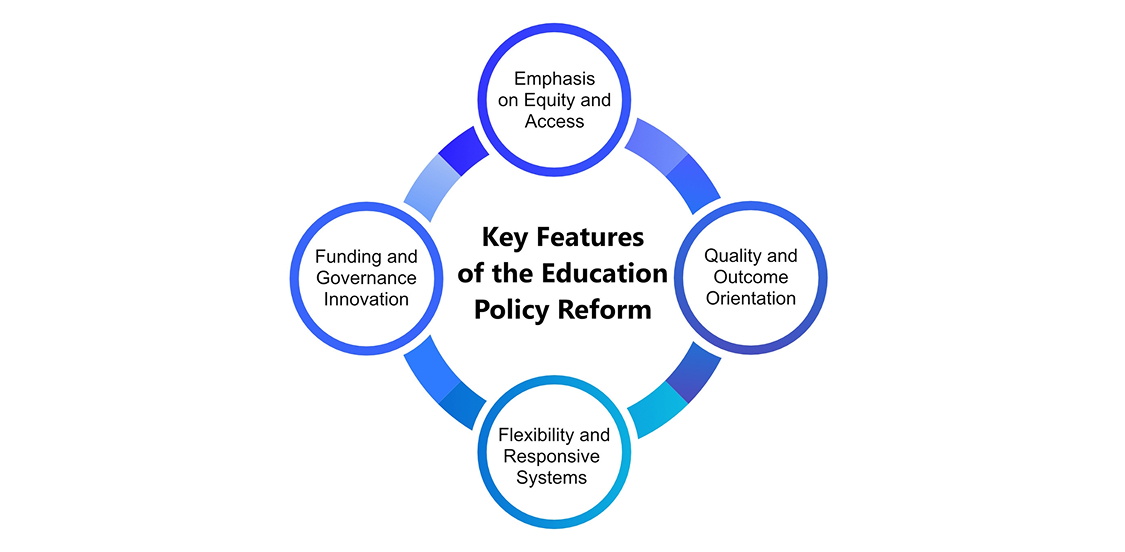
- Emphasis on Equity and Access: Reform efforts increasingly prioritise not just providing schooling, but ensuring fair distribution of resources, differentiated support for marginalised communities, and equal opportunities for success. Global frameworks emphasise that equity means more than treating all learners the same, it means responding to varied starting points and breaking down structural barriers.
- Quality and Outcome Orientation. Policies are shifting from input measures (such as how many teachers, or how many schools) toward outcomes, what learners actually know and can do. This demands better assessment systems, teacher capacity building, and learning analytics to identify and correct learning gaps early.
- Flexibility and Responsive Systems. Education policy is moving away from rigid, one-size-fits-all systems toward more adaptive models. These allow for multiple pathways: academic, technical, vocational, and enable learners to move between modes of education and work more fluidly. In higher education especially, policies increasingly support micro-credentials, blended formats, and international recognition.
- Funding and Governance Innovation. Reform also means rethinking how education is financed and managed. In many countries, public investment is insufficient, especially for reaching the most marginalised. Evidence suggests that private investment may widen inequalities if it focuses only on easier-to-reach populations. Good governance, transparency, and accountability become central to reform agendas.
Extensive Possibilities in Education Policy Transformation
While global education systems face numerous challenges, they also stand at the edge of immense opportunity. Forward-looking policies can transform how learning is accessed, delivered, and valued across societies.
- Digital Expansion: The accelerated integration of technology into education has opened doors to innovative teaching and learning practices. Online platforms, digital libraries, and open-access materials can bridge geographical divides, making quality education accessible even in remote areas. Moreover, the use of artificial intelligence and data analytics allows educators to personalise learning experiences and track progress more effectively, ensuring that no learner is left behind.
- Lifelong Learning: The growing emphasis on lifelong learning is reshaping the traditional idea of education as a one-time phase. Policies encouraging flexible learning pathways, vocational training, and online upskilling enable individuals to continuously acquire new competencies throughout their lives. Such adaptability ensures that workers can meet the evolving demands of modern industries and remain relevant in a technology-driven economy.
- Inclusive Reforms: Education policy reform offers the potential to close longstanding gaps in access and equity. Targeted interventions such as scholarships, differentiated funding, and community-based education programs can support underrepresented and marginalised groups. Inclusive policies that consider gender, disability, and socio-economic disparities not only enhance participation but also contribute to social justice and cohesive development.
- Global Collaboration: Increasingly, education is seen as a shared global responsibility. Aligning national frameworks with international learning standards enhances student mobility, academic recognition, and knowledge exchange. Cross-border collaborations also build research partnerships and cultural understanding, promoting a more interconnected and globally competent generation of learners.
Global Challenges in Education Policy Reform
Education policy reform is facing complex global challenges that require careful navigation. Policymakers must balance equity, quality, and international standards while responding to evolving social and economic demands.
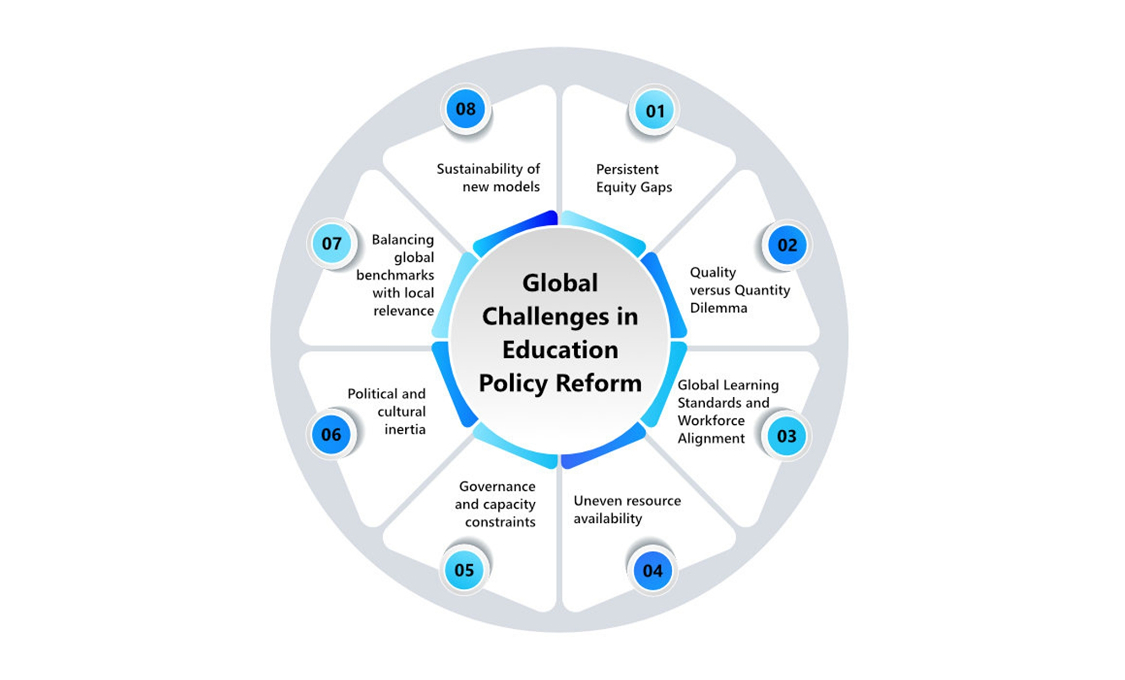
- Persistent Equity Gaps: Socioeconomic background, location, gender, disability and other intersecting factors continue to create stark disparities in opportunities and outcomes. Studies have shown that children from disadvantaged settings enter school with significantly lower foundational skills and often never catch up. Even where enrolment has increased, learning outcomes remain weak or highly unequal, particularly in lower-income regions.
- Quality versus Quantity Dilemma. The global drive to raise enrolment and achieve universal schooling has had real impact. Yet, many systems now face a “learning crisis,” where the quantity of learners is high but the quality of learning is low. This mismatch is especially acute when curriculums, teacher preparation, assessment systems, and school infrastructure lag behind evolving demands.
- Global Learning Standards and Workforce Alignment. Higher education and vocational sectors are receiving pressure to align with global standards, technological change, and workforce needs. As economies shift toward knowledge and digital sectors, policy must adjust to keep curricula and credentialing relevant. At the same time, institutions face international benchmarking, mobility of learners, and demands for more flexible pathways.
- Uneven Resource Availability: Many regions still face shortages of qualified teachers, learning materials, infrastructure, and research capacities.
- Governance and Capacity Constraints: Education ministries or agencies often operate under budget, lack flexibility, or lack data systems to fully track reform.
- Political and Cultural Inertia: Changing policies is one thing; shifting mindsets, practices, and stakeholders’ incentives is quite another challenge to tackle.
- Balancing Global Benchmarks with Local Relevance: Adopting global learning standards is useful, but ignoring local language, culture and community needs can lead to exclusion and disengagement.
- Sustainability of New Models: Pilot innovations may work in small scale, but scaling them, especially in resource-poor areas, remains a challenge.
Strategic Approaches in Educational Policy to Reduce Inequities
Given the scale of inequality and global challenges, policy reform must centre on several strategic spaces.
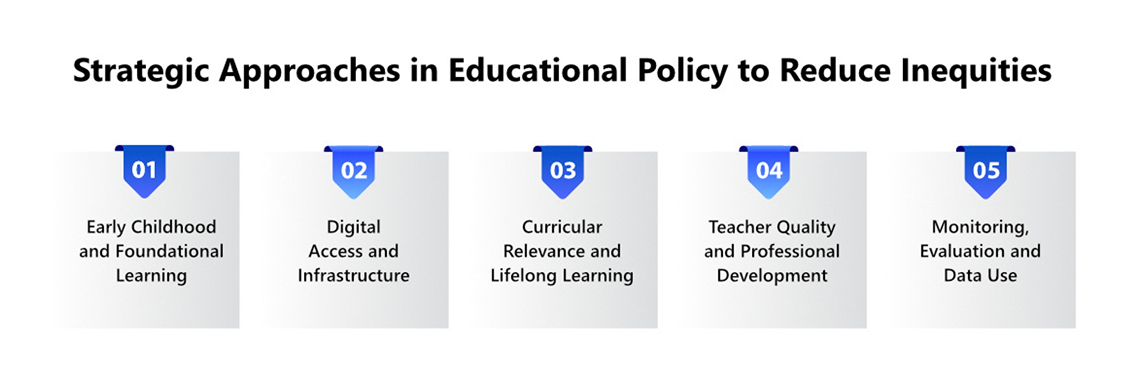
- Early Childhood and Foundational Learning: Evidence is clear that disparities in readiness often begin before children enter primary school. Children from less advantaged families arrive with weaker cognitive and non-cognitive skills, making it harder to catch up later. Strengthening early childhood programs, improving early assessment, and ensuring quality preparation are vital.
- Digital Access and Infrastructure: It is well-known that learners without reliable internet, devices, or home support are disproportionately affected in present educational scenario. Technology can enable innovation, but without equitable access it risks widening the gap. Policy needs to ensure infrastructure, support services, and inclusive design so digital tools don’t become a privilege.
- Curricular Relevance and Lifelong Learning. With the pace of change in global economies, curricula must evolve rapidly. Policy must support upskilling, continuous learning, and credential pathways that allow transitions across sectors. Lifelong learning frameworks, adult education, and stackable credentials are emerging as policy priorities.
- Teacher Quality and Professional Development. Teachers remain central to successful reform. Policy must focus on recruitment, retention, continuous professional growth, and motivation, particularly in underserved areas. Without strong educators, quality improvements are unlikely.
Also Read: A Guide to Teacher Professional Development
- 5. Monitoring, Evaluation and Data Use.To manage reform effectively, systems must have timely, accurate data. Traditional metrics may mask persistent inequality. Data must reflect learning outcomes, equity dimensions, and national contexts, not just enrolment rates. This allows policy to respond to gaps rather than assume all children are benefiting equally.
Looking Ahead: Reform Trajectories and Emerging Questions
The transition in education policy is far from complete. Looking ahead, several trends and questions will shape the landscape.
First, how will credential frameworks be aligned globally while still accommodating national sovereignty and diversity? How will systems ensure that new pathways like micro-credentials, digital learning and stackable degrees do not deepen inequity? Second, technology will continue to play a key role; but its design, access and governance will determine whether it narrows or widens gaps. Third, as climate change, migration and demographic shifts intensify, policy must become more agile to respond to new forms of inclusion, exclusion and skills demand. And finally, funding will remain a central question: how will nations sustain the cost of expanded access, improved quality and responsive systems?
These issues reinforce one key idea: policy in transition must not treat reform as a one-time event but as a continuous journey of adaptation, learning and equity.
Conclusion
Education policy in transition carries high stakes. The world is at a point where ignoring inequities or failing to align learning with global demands risks leaving whole cohorts behind. Reform efforts that focus equally on access, quality and relevance are essential for education systems to fulfil their promise. Without such emphasis, investments may generate schooling, but not learning. Yet policy change alone is not enough, implementation, resources and continuous adaptation matter. The goal should be clear, an education system where every learner, regardless of background or geography, can access high-quality learning, engage in meaningful credentialing, and prepare for a world of shifting standards and possibilities. When reform is grounded in equity and guided by data, it becomes a powerful lever for transformation across societies.
Latest
Trends blogs
- Skills and the Future of Work: How Employer Expectations Are Changing
- The Changing Role of Technology in Education: From Digital Classrooms to AI
- Preparing Universities for the AI Era: A Guide for Institutional Leaders
- The Future of AI Education: How Universities Are Equipping Students for Success
Focus blogs