

Aligning Education with Employability: The Power of Industry Certifications

The relationship between education and employment has undergone a significant shift in recent years. While traditional degrees continue to hold value, they are no longer seen as sufficient on their own to guarantee career readiness. Employers increasingly seek candidates who can demonstrate practical skills, adaptability, and familiarity with real-world tools and processes. This shift has placed growing emphasis on industry certifications as a means of bridging the gap between academic learning and professional expectations.
Industry certifications represent a structured way for learners to acquire validated, job-relevant skills alongside or beyond their formal education. They signal competence, credibility, and commitment to continuous learning. As higher education systems evolve to meet the demands of a rapidly changing job market, aligning education with employability has become a strategic priority. Industry certifications are emerging as an effective approach to achieving this alignment, reshaping how students learn, how institutions deliver value, and how employers evaluate talent.
Defining Industry Certifications in the Context of Higher Education
Industry certifications are credentials awarded upon successful completion of assessments that validate specific skills or knowledge areas relevant to a particular field. These certifications are typically designed with input from industry experts and emphasize practical application alongside conceptual understanding. This ensures that the learning outcomes are closely aligned with real-world tasks and professional expectations.
They span diverse domains and are often structured in levels, allowing learners to build competencies progressively. Their direct alignment with workplace expectations distinguishes them from traditional academic qualifications. In addition, their focused scope enables learners to develop targeted expertise in specific areas, making them particularly valuable in specialized roles.
The Growing Disconnect Between Academic Learning and Industry Requirements
The modern workforce is defined by rapid technological advancement, shifting industry requirements, and an increasing demand for specialized skills. Jobs are evolving faster than traditional curricula can adapt, creating a disconnect between what students learn and what employers need. This mismatch has led to concerns about graduate employability across sectors.
According to the World Economic Forum, 39% of core skills required in the global workforce are expected to change by 2030, reflecting the rapidly evolving expectations of employers and the need for more adaptable skill sets. This highlights the urgency of equipping learners with adaptable and relevant capabilities.
Industry certifications respond to this challenge by offering targeted, current training aligned with industry expectations, ensuring that learners remain relevant in a dynamic environment.
Addressing the Skills Gap Through Applied Learning
One of the most significant contributions of industry certifications is their role in addressing the persistent skills gap. Employers often struggle to find candidates who possess both theoretical knowledge and practical expertise. This gap is particularly evident in roles that demand immediate application of skills rather than extended on-the-job training.
By embedding certification pathways into academic programs, institutions enable students to gain
hands-on experience and apply their learning in real-world contexts. This approach enhances both confidence and competence, preparing graduates to contribute effectively in professional environments. It also encourages a more application-oriented learning mindset, where students engage with practical
problem-solving alongside academic study.
Key Advantages of Industry Certifications for Learners
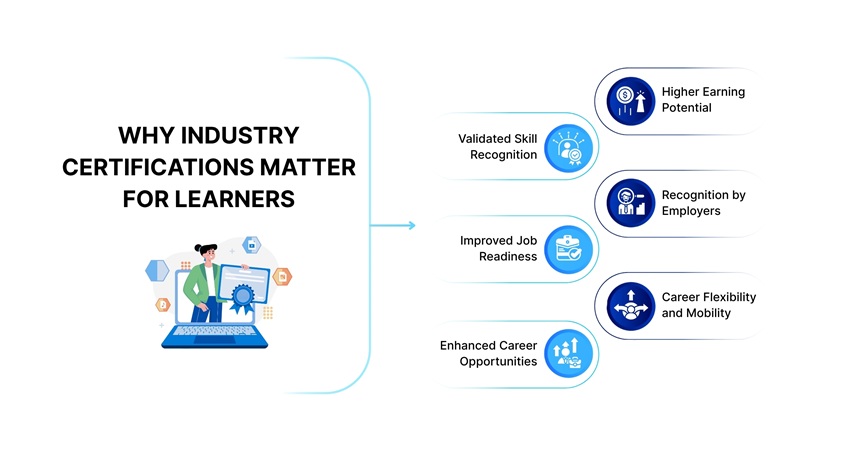
Industry certifications offer a distinct set of advantages that strengthen learners’ employability by validating skills and enhancing career readiness.
- Validated Skill Recognition
Certifications provide clear, measurable evidence of specific competencies. Unlike degrees that reflect broad knowledge, these credentials signal precise capabilities that employers can easily assess. - Improved Job Readiness
Learners gain exposure to industry-relevant tools, systems, and practices. This reduces the transition time from education to employment and enables quicker adaptation to workplace demands. - Enhanced Career Opportunities
Certifications strengthen professional profiles, making candidates more competitive in the job market. They often open access to specialized roles that require demonstrated expertise. - Higher Earning Potential
Individuals with certified skills are frequently considered for roles that demand advanced competencies, which can lead to improved compensation and career advancement. - Recognition by Employers
Recent data shows that 86% of employers consider professional certificates to be strong indicators of job readiness, reflecting a clear shift toward skills-based evaluation in hiring. This demonstrates the increasing reliance on certifications as credible proof of workplace capability and practical competence. - Career Flexibility and Mobility
Certifications allow individuals to transition across roles or industries by demonstrating relevant skills, even in the absence of direct experience in a new domain.
Integrating Certifications into Academic Frameworks
The inclusion of industry certifications is reshaping how higher education programs are structured. Institutions are increasingly embedding certification pathways within their curricula to enhance relevance and applicability. This shift also reflects a broader move toward outcome-driven education, where employability is a key measure of program effectiveness.
This integration involves incorporating experiential learning methods such as project-based assignments, simulations, and case-based learning. Certification preparation is aligned with course outcomes, enabling students to earn credentials alongside their degrees. In some cases, assessments are designed to mirror certification standards, further reinforcing practical skill development.
Such approaches strengthen the connection between academic learning and employment outcomes, enhancing the overall value of education. They also help institutions demonstrate clearer career pathways for students, making their programs more aligned with industry expectations.
Continuous learning has become essential in a rapidly evolving job market. Industry certifications support this by offering flexible pathways for skill enhancement at different stages of a career. They enable professionals to update their knowledge in line with changing role requirements without stepping away from their jobs for extended periods.
Their modular structure allows individuals to build expertise progressively, ensuring ongoing relevance and adaptability in changing professional environments. This step-by-step approach also encourages consistent upskilling, helping individuals remain competitive and responsive to shifting career opportunities.
Employer Perspectives on Certification-Based Competence
Employers prioritize candidates who can demonstrate immediate value. Industry certifications serve as reliable indicators of competence, providing standardized benchmarks for evaluating skills. In many sectors, these credentials help hiring managers quickly identify candidates who possess role-specific capabilities, especially when dealing with large applicant pools. This growing reliance on skills-based validation reflects a broader shift toward practical expertise as a key hiring criterion.
They reduce uncertainty in hiring by confirming that candidates meet defined competency standards. Additionally, certifications reflect initiative and a commitment to professional development, which are qualities that are highly regarded in the workplace. Candidates who pursue certifications are often perceived as more proactive and better prepared to adapt to evolving job requirements. This perception strengthens their credibility and can influence both hiring decisions and early career progression.
Key Challenges in Implementing Industry Certifications
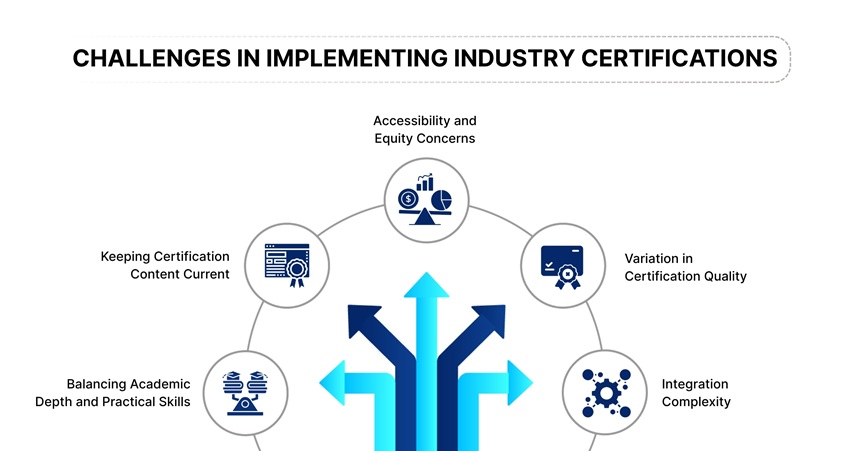
While industry certifications offer clear benefits, their integration into higher education also presents several practical and strategic challenges that need careful consideration.
- Balancing Academic Depth and Practical Skills
Integrating certifications into curricula requires careful planning to ensure that practical training does not compromise theoretical understanding. Both aspects must complement each other to provide a well-rounded education. - Keeping Certification Content Current
Rapid changes in industry practices necessitate frequent updates to certification programs. Maintaining alignment with evolving standards can be resource-intensive for institutions. - Accessibility and Equity Concerns
Not all students may have equal access to certification opportunities due to cost, infrastructure, or resource limitations. Addressing these disparities is essential for inclusive education. - Variation in Certification Quality
The value of certifications can vary depending on their relevance and recognition within specific industries. Ensuring the credibility of selected certifications is critical. - Integration Complexity
Embedding certification pathways into existing academic structures can be challenging. It requires curriculum redesign, faculty training, and alignment with assessment methods.
The Evolving Relationship Between Education and Employment
The connection between education and employment is becoming increasingly direct, with a growing emphasis on measurable skills and competencies. Industry certifications are expected to play a central role in this transformation. Employers are placing greater value on demonstrable abilities rather than solely on academic credentials, prompting institutions to rethink how learning outcomes are defined and assessed. As a result, education is gradually shifting toward models that integrate skill validation alongside knowledge acquisition, ensuring that graduates are better aligned with workplace expectations.
Emerging trends such as micro-credentials and digital learning platforms are making certifications more accessible and adaptable. These developments enable learners to acquire skills efficiently and demonstrate their competencies in flexible ways. Additionally, shorter, stackable credentials are gaining traction as they allow learners to build expertise progressively without committing to long-term programs. The increasing collaboration between academia and industry in designing such credentials further enhances their relevance, ensuring that learning remains closely connected to evolving professional demands.
Institutions that embrace these changes will be better positioned to align education with workforce demands.
Step into Global Education Leadership
Explore Global Fellow Programs in Higher Education Management and School Leadership
Conclusion
Aligning education with employability is a critical priority in today’s dynamic environment. Industry certifications offer a practical and effective approach to bridging the gap between academic learning and professional requirements.
By validating skills, enhancing job readiness, and supporting continuous development, certifications provide significant value to learners, institutions, and employers. They ensure that graduates are equipped not only with knowledge but also with the competencies required to succeed in professional settings.
As higher education continues to evolve, the integration of industry certifications will remain central to delivering relevant and impactful learning experiences, ultimately strengthening the connection between education and long-term career success.
Frequently Asked Questions
1. What are industry certifications and how do they differ from academic degrees?
Industry certifications are credentials that validate specific, job-relevant skills through standardized assessments. Unlike academic degrees, which provide broad theoretical knowledge, certifications focus on practical competencies directly aligned with industry requirements.
2. Why are industry certifications becoming important in higher education?
Industry certifications are gaining importance because they help bridge the gap between academic learning and workplace expectations. They equip students with relevant, up-to-date skills that improve employability and job readiness.
3. Do industry certifications improve employment opportunities?
Yes, industry certifications enhance employment prospects by providing verifiable proof of skills. Employers often view certified candidates as more prepared for specific roles, which can increase hiring potential and career advancement opportunities.
4. Can industry certifications be pursued alongside a degree program?
Yes, many higher education institutions are integrating certification pathways into their curricula. This allows students to earn certifications alongside their degrees, strengthening their professional profile without extending their study duration.
5. Are industry certifications useful for long-term career growth?
Industry certifications support long-term career growth by enabling continuous skill development. Professionals can use them to upskill, reskill, or transition into new roles, ensuring they remain relevant in a changing job market.
Latest
Trends blogs
- Skills and the Future of Work: How Employer Expectations Are Changing
- The Changing Role of Technology in Education: From Digital Classrooms to AI
- Preparing Universities for the AI Era: A Guide for Institutional Leaders
- The Future of AI Education: How Universities Are Equipping Students for Success
Focus blogs