


From Paper to Proof: How Blockchain is Reshaping Academic Credentials

Academic credentials are evolving from paper records and isolated databases into dynamic, verifiable digital assets. As learning increasingly moves across borders and platforms, the need for secure, reliable, and easily verifiable academic credentials has become more important than ever. Traditional systems of maintaining educational records, which often rely on centralized databases and physical documentation, face challenges related to security, authenticity, and accessibility.
Amid these changes, blockchain technology is emerging as a promising solution to address these limitations. By offering a decentralized, immutable system for recording and verifying information, blockchain has the potential to redefine how academic credentials are issued, stored, and shared. Its application in education goes beyond technological innovation, representing a shift toward greater transparency, trust, and efficiency in credential management.
Understanding the Limitations of Traditional Credential Systems
Conventional methods of managing academic records often rely on multiple intermediaries, including institutions and verification agencies, which can lead to delays, inefficiencies, and increased administrative burden. Verifying credentials, especially across institutions or countries, is often time-consuming and prone to errors.
Another major concern is the risk of credential fraud, as fake degrees and altered transcripts can undermine trust in educational systems. Centralized databases are also vulnerable to data breaches and unauthorized changes. In addition, learners have limited control over their records, as accessing or sharing credentials typically depends on institutional processes, which can be restrictive in a global context.
Blockchain Technology: A Transformative Approach
Blockchain technology offers a fundamentally different approach to data management by using a decentralized ledger where information is stored in secure, linked blocks. Once recorded, data cannot be altered without consensus, making the system highly resistant to tampering and ensuring strong data integrity.
In education, this enables academic credentials to be securely stored and easily verified without intermediaries, improving both efficiency and trust among learners, institutions, and employers. Recent research shows that blockchain-based credential systems can reduce verification time from several days to just a few seconds, significantly improving efficiency and eliminating delays in academic record validation. Its decentralized structure also reduces dependence on a single authority, enhancing reliability and minimizing risks related to system failures or data manipulation.
Securing Academic Credentials and Enabling Learner Ownership
Blockchain significantly strengthens the security and authenticity of academic credentials by ensuring that once a record is added, it becomes fixed and cannot be altered or deleted. This eliminates the risk of fraudulent modifications and creates a reliable system for storing verified information such as courses, grades, and achievements. As a result, employers and institutions can access and validate credentials instantly without relying on lengthy verification processes, improving efficiency and decision-making.
At the same time, blockchain shifts control of credentials from institutions to individuals, allowing learners to store their records in digital wallets and share them directly when needed. This provides greater autonomy and is especially valuable in a globalized environment where mobility is common. Additionally, it supports lifelong learning by enabling individuals to compile credentials from multiple sources into a single, secure record, making achievements easily accessible and transferable across different contexts.
Supporting Global Mobility and Recognition
As education becomes increasingly global, the demand for credentials that are universally recognized and easily transferable continues to grow. Blockchain addresses this need by offering a secure and standardized framework for managing academic records, ensuring consistency and reliability across different systems.
With blockchain-based credentials, qualifications issued in one country can be quickly verified and accepted in another, improving mobility for students and professionals. This seamless verification reduces barriers related to credential recognition and supports smoother transitions across institutions and job markets. Additionally, it enables greater collaboration between institutions through easier exchange of academic records and the development of joint programs, contributing to a more connected and inclusive education ecosystem.
Integration with Emerging Education Technologies
Blockchain does not operate in isolation; its impact increases when integrated with other digital technologies. When combined with artificial intelligence, it can support deeper analysis of learning outcomes and skill development. Integration with online learning platforms also enables the automatic issuance and verification of digital credentials, improving both speed and reliability.
This combination enhances the efficiency of education systems by allowing learners to receive verified credentials immediately after completing courses. At the same time, institutions can maintain secure and accurate records with minimal administrative effort. It also supports micro-credentialing, where learners earn certifications for specific skills that can be accumulated over time, creating a comprehensive and verifiable record of their learning journey.
Together, these capabilities highlight how blockchain strengthens core aspects of credential management, setting the stage for a closer look at the practical advantages it brings to academic systems.
Unlocking the Advantages: How Blockchain Strengthens Academic Credentialing
The true value of blockchain in education becomes evident when examining the practical advantages it brings to academic credentialing systems.
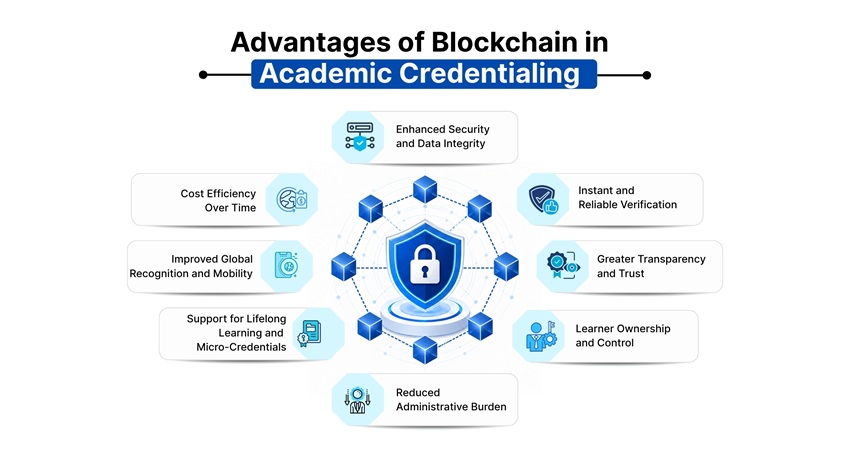
- Enhanced Security and Data Integrity
Blockchain ensures that academic records are stored in a tamper-resistant environment where data cannot be altered once recorded. This significantly reduces the risk of fraud, duplication, or unauthorized modifications, preserving the authenticity of credentials.
- Instant and Reliable Verification
Credentials recorded on blockchain can be verified in real time without relying on intermediaries. This eliminates lengthy verification processes and allows employers or institutions to access accurate information quickly and efficiently.
- Greater Transparency and Trust
The transparent nature of blockchain systems enables all authorized stakeholders to access consistent and verifiable records. This builds trust between learners, educational institutions, and employers by ensuring that credentials are credible and easily traceable.
- Learner Ownership and Control
Blockchain gives individuals direct control over their academic records, allowing them to store and share their credentials independently. This empowers learners to manage their achievements without depending on institutions for access or verification.
- Reduced Administrative Burden
Automating credential issuance and verification minimizes the need for manual processes, reducing administrative workload for institutions. Latest analyses reveal that blockchain-based credential systems can reduce administrative workload by up to 50% by automating verification processes and eliminating manual checks, significantly improving institutional efficiency. This allows educational organizations to allocate resources more efficiently.
- Support for Lifelong Learning and Micro-Credentials
Blockchain enables the secure storage of credentials from multiple sources, including short courses and skill-based certifications. This supports lifelong learning by creating a unified record of an individual’s continuous education journey. The HR Director report implies that 75% of learners prefer programs that include micro-credentials, highlighting the increasing demand for flexible and continuous learning pathways.
- Improved Global Recognition and Mobility
Blockchain-based credentials can be easily shared and verified across borders, enhancing global recognition. This facilitates smoother transitions for students and professionals seeking opportunities in different regions.
- Cost Efficiency Over Time
By reducing reliance on intermediaries and minimizing verification processes, blockchain can lower long-term operational costs associated with credential management and validation.
Key Challenges in Implementing Blockchain for Education
Despite its potential, implementing blockchain in education involves several practical challenges that must be carefully addressed.
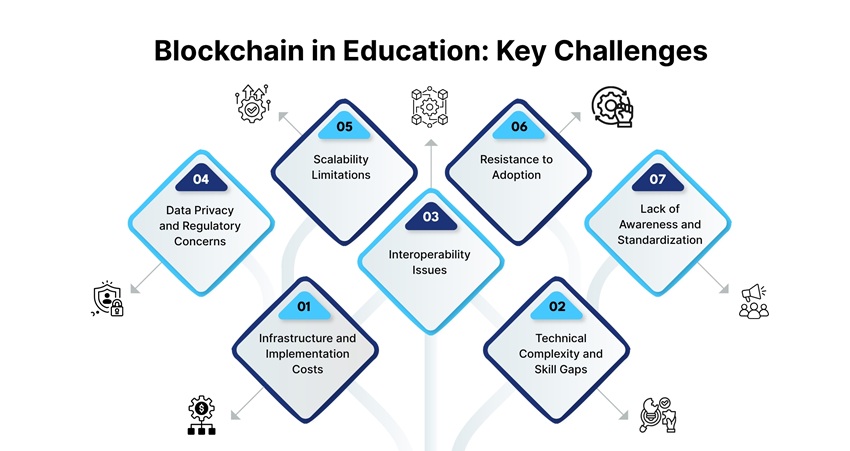
- 1. Infrastructure and Implementation Costs
Adopting blockchain systems requires significant initial investment in technology, infrastructure, and system integration. For many institutions, especially in developing regions, these costs can act as a major barrier to adoption.
- 2. Technical Complexity and Skill Gaps
Blockchain is still a relatively advanced technology that demands specialized knowledge. Limited technical expertise among educators and administrators can slow down implementation and affect effective usage.
- 3. Interoperability Issues
Different blockchain platforms may not always be compatible with one another. Lack of standardized frameworks can create challenges in sharing and verifying credentials across systems and institutions.
- 4. Data Privacy and Regulatory Concerns
While blockchain ensures data security, managing sensitive educational information requires strict privacy controls. Ensuring compliance with data protection regulations and controlling access to personal data remain critical challenges.
- 5. Scalability Limitations
As the number of users and records increases, maintaining efficiency and speed in blockchain systems can become challenging. Scaling the technology to support large educational ecosystems requires further development and optimization.
- 6. Resistance to Adoption
Educational institutions often rely on established systems and may be hesitant to transition to new technologies. Resistance from stakeholders, including administrators and policymakers, can slow down widespread adoption.
- 7. Lack of Awareness and Standardization
Limited understanding of blockchain’s potential in education can hinder its acceptance. Additionally, the absence of universally accepted standards makes it difficult to implement consistent and scalable solutions.
The Future of Blockchain in Education
The role of blockchain in education is expected to expand as digital transformation continues. Its ability to provide secure, transparent, and efficient credential management aligns with the evolving needs of modern education systems.
As more institutions explore blockchain-based solutions, the potential for creating a unified and globally recognized credential ecosystem becomes increasingly achievable. This could lead to greater trust, reduced fraud, and improved accessibility in education.
Moreover, the continued development of technology and standards will likely address existing challenges, making blockchain more accessible and scalable. This progress will further strengthen its role in shaping the future of education.
Enhancing Higher Education with Generative AI
A practical guide to leveraging generative AI while ensuring ethics, transparency, and academic integrity in modern institutions.
Conclusion
The need for secure, reliable, and accessible academic credentials is increasing in a digital and globalized world. While traditional systems remain functional, they often limit efficiency, transparency, and trust. Blockchain offers a transformative approach by redefining how credentials are issued, stored, and verified.
By enhancing security, empowering learners, and simplifying verification, blockchain can significantly improve credential management in education. Despite existing challenges, it provides a clear pathway toward more efficient and trustworthy systems, supporting a more transparent and future-ready learning ecosystem.
Frequently Asked Questions (FAQs)
How does blockchain improve the security of academic credentials?
Blockchain records are tamper-resistant and cannot be altered once stored, which prevents fraud, duplication, and unauthorized changes to academic data.
How do learners benefit from blockchain-based credentials?
Learners gain greater control over their records, allowing them to store, access, and share credentials independently without relying on institutions for verification.
Is blockchain-based credential verification faster than traditional methods?
Yes, blockchain enables real-time verification, eliminating the need for manual checks and reducing delays associated with traditional processes.
How does blockchain support lifelong learning?
It allows individuals to store credentials from multiple sources, including courses, certifications, and training programs, creating a unified and verifiable record of continuous learning.
What challenges are associated with implementing blockchain in education?
Key challenges include high implementation costs, technical complexity, interoperability issues, data privacy concerns, and resistance to adoption.
Latest
Trends blogs
- Preparing Universities for the AI Era: A Guide for Institutional Leaders
- The Future of AI Education: How Universities Are Equipping Students for Success
- Building AI Literacy and Workforce Skills in Higher Education
- Intelligent Learning Systems: The Rise of Agentic AI in Higher Education
Focus blogs